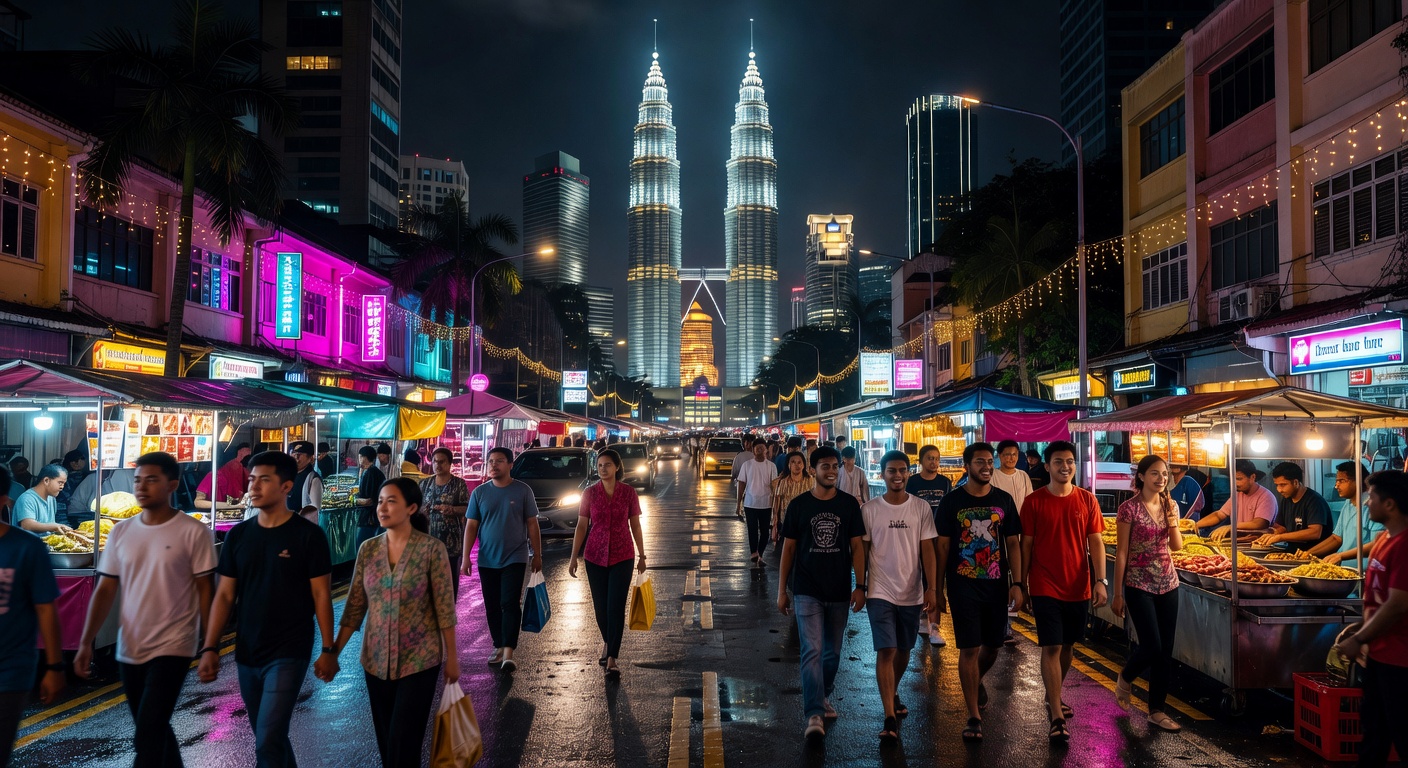
Regional Guide
Malaysia
A Southeast Asian nation with a dual legal system where Sharia and civil law coexist — prostitution is illegal under both, yet a significant industry operates through KTV bars, massage parlors, and online freelancers across Kuala Lumpur, Penang, and Johor Bahru.
At a glance: Malaysia
- Legal model
- Illegal
- FCDO advisory
- Avoid travel
- HIV prevalence
- 0.3% adult →
- PrEP access
- Subsidised
- Syphilis (sex workers)
- 1.4%
- Currency
- Malaysian Ringgit (MYR)
- Language
- Malay, English, Mandarin, Tamil
- Population
- 32.4M
- Capital
- Kuala Lumpur
- Last verified
ART: 63% · WHO 2025
MYR 50–150/month
MSM: 10.9% · WHO 2023
Government travel advisories
Pre-travel medical — vaccines & medicines(12 · CDC)
- COVID-19Recommended
All eligible travelers should be up to date with their COVID-19 vaccines. Please see Your COVID-19 Vaccination for more information.
- Hepatitis ARecommended
Recommended for unvaccinated travelers one year old or older going to Malaysia. Infants 6 to 11 months old should also be vaccinated against Hepatitis A.
- Hepatitis BRecommended
Recommended for unvaccinated travelers younger than 60 years old traveling to Malaysia. Unvaccinated travelers 60 years and older may get vaccinated before traveling to Malaysia.
- MalariaRecommended
CDC recommends that travelers going to certain areas of Malaysia take prescription medicine to prevent malaria.
- MeaslesRecommended
Cases of measles are on the rise worldwide. Travelers are at risk of measles if they have not been fully vaccinated at least two weeks prior to departure, or have not had measles in the past, and trav…
- TyphoidRecommended
Recommended for most travelers, especially those staying with friends or relatives or visiting smaller cities or rural areas.
- RabiesConsider
Dogs infected with rabies are sometimes found in Malaysia. If rabies exposures occur while in Malaysia, rabies vaccines are typically available throughout most of the country.
- Routine vaccinesRoutine
Make sure you are up-to-date on all routine vaccines before every trip.
- ChikungunyaNot recommended
All travelers should take steps to prevent mosquito bites. Chikungunya vaccination is generally not recommended.
- CholeraNot recommended
There is no longer active cholera transmission and vaccine is not recommended.
- Japanese EncephalitisNot recommended
Recommended for travelers who Are moving to an area with Japanese encephalitis to live Spend long periods of time, such as a month or more, in areas with Japanese encephalitis Frequently travel to are…
- Yellow FeverNot recommended
CDC recommendations: Vaccine is not recommended. Country entry requirements: Direct travel from United States: Vaccine is not required.
General guidance from the CDC Travelers' Health page (2026-07-23) — not medical advice. See a travel clinic 4–6 weeks before departure. Malaria and some vaccines depend on your specific itinerary.
Common questions about Malaysia
What people are actually searching for.
Is sex work allowed in Malaysia?
No, sex work is not allowed in Malaysia. All forms of commercial sex are illegal under civil law, and Sharia courts apply additional penalties — including caning — to Muslim citizens caught engaging in it. The country operates a fully prohibitionist model, meaning both selling and buying sexual services carry criminal liability. Enforcement can be selective but genuine: raids on massage parlours, hotels and entertainment venues in Kuala Lumpur, Penang and Johor Bahru are routine. The UK FCDO currently posts a Warning-level advisory for Malaysia, and drug laws are among the harshest in the world, with the death penalty still on the books for trafficking. Section 377 sodomy provisions carry up to 20 years' imprisonment plus caning and are used against men who have sex with men. The minimum legal age for anyone in adult work would be 18.
Is there a red district in Malaysia?
Malaysia does not have any officially designated red-light district — commercial sex is illegal nationwide, so no zone is formally sanctioned. In practice, however, several areas are historically associated with the vice trade. Bukit Bintang in Kuala Lumpur is known for hotel-based escorting, Petaling Jaya has a well-established massage parlour scene, Georgetown in Penang contains a historic vice quarter, and Johor Bahru functions as a weekend cross-border destination for visitors from Singapore. Typical quoted prices in these informal scenes run MYR 600–1,500 (roughly USD 130–325), though transactions remain criminal. Because all activity is underground, raids, extortion and arrest risk are real. Muslims face additional Sharia-court penalties including caning, and the UK FCDO maintains a Warning-level travel advisory for the country.
What is the age of consent for men in Malaysia?
The general age of consent in Malaysia is 16, and it applies to heterosexual relations regardless of the man's or woman's gender. However, the picture is very different for men who have sex with men. Section 377 of the Penal Code criminalises "carnal intercourse against the order of nature" — effectively sodomy — with penalties of up to 20 years' imprisonment plus caning, and it is applied selectively against MSM regardless of consent or age. That means there is no functional age of consent for same-sex male activity in Malaysia; it remains criminal at any age. Muslim men face further sanctions in Sharia courts. Separately, anyone participating in commercial adult work must be at least 18, though such work is itself illegal under civil law.
Is 17 still a minor in Malaysia?
For most purposes relevant to adult travel, yes — a 17-year-old in Malaysia is still legally a minor. The Age of Majority Act sets adulthood at 18, and Malaysia's minimum age for any form of sex work is likewise 18, so a 17-year-old cannot lawfully be involved in commercial sexual activity under any circumstances. The general age of consent for private, non-commercial heterosexual relations is 16, meaning a 17-year-old is above that threshold in that narrow context. However, same-sex male activity remains prohibited at any age under Section 377, which carries up to 20 years plus caning. Muslim minors are additionally subject to Sharia jurisdiction. Any sexual contact involving someone under 18 in a commercial setting is treated as a serious criminal offence.
Is red light area legal in Malaysia?
No, red-light areas are not legal in Malaysia. The country follows an all-illegal model in which every form of commercial sex — solicitation, brothel-keeping, pimping and buying — is prohibited under civil law. There is no zoning framework, no licensing regime and no tolerated district anywhere in the country. Muslim citizens face additional penalties in the Sharia court system, including caning. Informal scenes do exist in Bukit Bintang (Kuala Lumpur), Petaling Jaya's massage parlours, Georgetown in Penang and Johor Bahru near the Singapore border, but all operate underground and are subject to police raids, arrests and, for foreigners, deportation. The UK FCDO issues a Warning-level advisory for Malaysia, and travellers should also note that drug offences can attract the death penalty.
In what country is prostitution fully legal?
Malaysia itself is not a country where prostitution is legal — all forms of commercial sex are prohibited under Malaysian civil law, with additional Sharia penalties, including caning, for Muslims. It sits at the strictest end of the legal spectrum, alongside a Warning-level UK FCDO advisory and some of the world's harshest drug laws. Because worldadultguide.com's country brief for Malaysia only documents Malaysian law, we cannot responsibly name specific foreign jurisdictions here without their own country context. Broadly speaking, a small number of countries do fully legalise and regulate the industry, while others decriminalise it; readers interested in those regimes should consult the relevant country pages on this site. What is unambiguous is that Malaysia is not one of them, and enforcement risk for both workers and clients inside the country is high.
Is there any red light area in Kuala Lumpur?
Kuala Lumpur has no legally recognised red-light area, because commercial sex is illegal throughout Malaysia. The best-known informal scene centres on Bukit Bintang, where hotel-based escorting is associated with the district's nightlife strip. Nearby Petaling Jaya, part of the greater KL conurbation, has a longstanding massage parlour scene. Quoted prices in these underground markets typically fall in the MYR 600–1,500 range (roughly USD 130–325), but any transaction remains a criminal offence and Muslim participants also face Sharia penalties, including caning. Enforcement is real: police raids on hotels, spas and entertainment outlets occur regularly, and foreigners caught can face detention and deportation. The UK FCDO maintains a Warning-level advisory for Malaysia, and Section 377 sodomy laws (up to 20 years plus caning) are applied selectively against MSM.
Are there strip bars in Malaysia?
Malaysia does not have a legal strip-bar industry. Because all forms of commercial sex are prohibited under civil law, and Sharia courts impose additional penalties on Muslims including caning, licensed nude or topless entertainment is not part of the country's nightlife offering. Kuala Lumpur's Bukit Bintang district and Petaling Jaya do host conventional bars, clubs and massage parlours, and Georgetown in Penang and Johor Bahru have their own nightlife scenes, but any venue offering overt stripping would be operating outside the law and vulnerable to raids. Travellers should also be aware that Malaysia enforces some of the world's harshest drug laws, with the death penalty for trafficking, and that Section 377 sodomy provisions carry up to 20 years plus caning. The UK FCDO currently rates Malaysia at Warning level.
Legal Model
Criminalized
Risk Level
High
Currency
Malaysian Ringgit (MYR / RM)
Language
Malay / English / Mandarin
Tipping
Not customary
Emergency
999 (Police / Ambulance)
Legal Framework
Malaysia operates a dual legal system: civil law applies to all citizens, while Sharia (Islamic) law applies additionally to ethnic Malays and other Muslims (approximately 60% of the population). Prostitution is illegal under both systems, but the penalties and enforcement differ.
Under civil law, soliciting for the purpose of prostitution is an offense under the Penal Code (Section 372). Organizing, managing, or living off prostitution earnings are more serious offenses carrying up to 15 years imprisonment. The client's criminal exposure is primarily through solicitation charges.
Under Sharia law (applicable to Muslims), "khalwat" (close proximity between unmarried men and women) is a criminal offense, as are zina (fornication/adultery) and related moral offenses. Sharia enforcement officers (JAKIM at the federal level, state-level agencies) conduct raids on hotels, apartments, and venues. Non-Muslim foreigners are generally not subject to Sharia law, but being involved in an incident with a Muslim person can create complications.
Key legal realities:
- Dual legal system creates complexity — As a non-Muslim foreigner, you are subject to civil law only. However, if your partner is Muslim, they face Sharia penalties and the situation becomes far more complicated for both parties.
- JAKIM raids — Islamic enforcement agencies conduct surprise raids on hotels and private premises, particularly during Ramadan and religious holidays. These typically target Muslim Malays but can sweep up foreigners as well.
- Age of consent is 16 for non-commercial sex; any commercial activity involving persons under 18 is severely penalized.
- Deportation risk — Foreigners caught in prostitution-related offenses face deportation and entry bans.
Sharia Law Warning
Malaysia's dual legal system means that encounters involving Muslim partners carry additional and significant legal risks. Sharia enforcement agencies (JAKIM) conduct raids, particularly during Ramadan and Islamic holidays. While non-Muslims are not directly subject to Sharia law, being present during a raid creates serious complications. Be aware of your partner's background and the current enforcement climate.
How It Works
Malaysia's adult industry operates through several distinct channels, shaped by the country's multicultural composition and legal landscape.
KTV / Karaoke bars follow the Chinese model (reflecting Malaysia's significant Chinese minority). You rent a private room, select hostesses (referred to as GROs — Guest Relations Officers), and socialize over drinks and singing. If you want to take a hostess out, you pay a release fee to the establishment and negotiate services separately. KTV venues range from basic to luxurious and are concentrated in areas with large Chinese populations.
Massage parlors are widespread throughout Malaysian cities. The model is familiar: legitimate massage front, with extras available at certain establishments. Providers at massage parlors are often from Indonesia, Vietnam, Thailand, or China. Services range from basic hand finish to full service, depending on the establishment and the individual provider.
Online freelancers operate through messaging apps (WeChat, WhatsApp) and classified ad sites. Contact is initiated online, arrangements are made for hotel or apartment visits, and terms are agreed in advance. This channel has grown significantly and offers the most discretion.
Payment is cash in Malaysian ringgit. Some providers in tourist areas accept US dollars or Singapore dollars (particularly in Johor Bahru). Agree on the amount and currency before the encounter.
Venue Types
KTV / Karaoke Bars
The most established venue type, modeled on the Chinese KTV system. Malaysia's Chinese community (approximately 23% of the population) supports a large KTV industry, particularly in KL, Penang, and Johor. Venues range from modest neighborhood karaoke lounges to multi-story entertainment complexes. The process involves renting a room, selecting GROs from a lineup or from circulating hostesses, ordering drinks, and negotiating any additional arrangements. Higher-end KTVs employ attractive hostesses and charge premium prices. The release fee to take a hostess out typically ranges from RM200–500.
Massage Parlors
Extremely common throughout Malaysia. From small shophouse operations to larger spa-style establishments, massage parlors with extras can be found in all major cities. Visual identifiers include pink/red lighting, late hours, and suggestive signage. Many employ foreign workers (Thai, Vietnamese, Indonesian, Chinese). Pricing is generally affordable. The "freelance massage" category — independent masseuses who visit your hotel — has grown through online platforms.
Freelancers (Online)
An increasingly dominant channel. Independent providers and agency-managed workers advertise through classified sites, WeChat groups, WhatsApp, and social media. Arrangements are made for hotel visits or incall at rented apartments. The online market includes Malaysian, Chinese, Vietnamese, Thai, Indonesian, and other nationalities. Verification of photos and identity before meeting is advisable.
Escort Services
Organized escort agencies operate in Kuala Lumpur, providing booking services through phone or online platforms. These agencies manage portfolios of providers and handle scheduling, often adding a premium to the provider's direct rate. Quality control tends to be more consistent through agencies, though prices are higher than independent contacts.
Nightclub Freelancers
KL's nightclub scene, particularly in the Bukit Bintang area, attracts freelancers who blend with regular clubgoers. Connections happen through normal social interaction. This channel is less structured and more dependent on interpersonal dynamics. Language is rarely a barrier in KL's English-friendly club scene.
Notable Venues & Establishments
Malaysia's adult entertainment venues operate discreetly due to the legal and cultural environment. The following represent well-known areas and venue categories.
Bukit Bintang KTV & Nightlife (Kuala Lumpur)
KL's primary entertainment district. Jalan Bukit Bintang and surrounding streets (Changkat Bukit Bintang, Jalan Alor) host numerous KTV venues, bars, nightclubs, and massage parlors. The area is walkable, well-lit, and heavily trafficked by tourists. Several multi-floor KTV complexes operate in the side streets off the main drag. Nightclubs like Zouk, Kyo, and various venues along Changkat serve as meeting points for the freelancer scene.
Jalan Alor Area Massage (Kuala Lumpur)
The streets around KL's famous food street (Jalan Alor) have a concentration of massage establishments, many offering extras. These are convenient for tourists staying in the Bukit Bintang area. Quality varies from basic to decent. Pricing is among the most affordable in KL's tourist zone.
Chow Kit Area (Kuala Lumpur)
A more local and budget-oriented area north of the city center. Chow Kit has massage parlors, budget hotels, and a street scene. The area is grittier and less tourist-friendly than Bukit Bintang. It primarily serves local Malaysian and migrant worker clientele. Foreigners will stand out, which increases both attention and potential police interest.
Georgetown KTV District (Penang)
Penang's George Town, a UNESCO World Heritage site, has a KTV and entertainment scene concentrated in the newer commercial areas rather than the heritage zone. Several KTV complexes operate along the main commercial corridors. The Penang scene is smaller than KL but caters to both local Chinese Malaysian clients and visitors from nearby countries.
Johor Bahru Entertainment Zone
JB, located directly across the causeway from Singapore, has developed a significant entertainment scene partly driven by Singaporean visitors seeking lower prices. KTV venues, massage parlors, and hotels in areas near the customs checkpoint cater to this cross-border traffic. The city center and Taman Molek area have concentrations of entertainment venues. Prices are a fraction of Singapore rates.
Kota Kinabalu Waterfront (Sabah)
KK's waterfront and city center area has a smaller but active entertainment scene. KTV bars, massage parlors, and nightlife venues serve both tourists and the local population. The East Malaysian atmosphere is more relaxed than Peninsular Malaysia, and enforcement is generally less stringent.
Services & What's Included
KTV / Karaoke
- Room rental (RM100–500/hr): Private karaoke room with sound system. Larger rooms for groups cost more.
- GRO companionship (RM50–200/girl): Sitting fee for each hostess. Covers singing, drinking, and socializing.
- Drinks (RM200–2,000+): Minimum spend on alcohol is usually required. Whisky and beer are standard. Prices are heavily marked up.
- Release fee (RM200–500): Fee to take a hostess out of the venue. Paid to the establishment.
- Full service (RM200–800): Negotiated directly with the hostess after leaving. Includes hotel or short-time room.
Massage Parlors
- Base massage (RM60–150, 60 min): Legitimate oil or Thai massage. Paid to the establishment.
- Hand service (RM50–150): Basic extras. Paid as a "tip" to the masseuse.
- Full service (RM150–500): Complete services. Paid to the masseuse. Room included.
- Freelance hotel massage (RM200–600): Independent masseuse visits your hotel. Full service often included or negotiated on arrival.
Online Independents / Escorts
- Short time (RM300–800, 1–2 hrs): Standard session. Full service with one or two rounds. Hotel visit or incall at provider's apartment.
- Overnight (RM600–1,500+): Evening through morning. Includes social time and multiple sessions.
- Premium / model tier (RM1,000–3,000+): High-end providers. Often Chinese or international. GFE experience.
- Travel/outcall supplement (RM50–200): Additional charge for travel to your hotel.
Pricing Guide
| Venue | Time | Local (MYR) | USD | What's Included | Notes |
|---|---|---|---|---|---|
| KTV (full evening) | 2–4 hrs | RM800 – RM3,000+ | $175 – $655+ | Room, GROs, drinks, release fee | Total cost; drinks drive the bill |
| KTV take-out only | 1–2 hrs | RM200 – RM800 | $43 – $175 | Release fee + full service | Negotiated with hostess separately |
| Massage (extras) | 60–90 min | RM150 – RM500 | $33 – $109 | Massage + hand or full service | Base massage + tip for extras |
| Online independent | 1–2 hrs | RM300 – RM1,500 | $65 – $327 | Full service, 1–2 rounds | Wide range by nationality and quality |
| Premium / model | 1–2 hrs | RM1,000 – RM3,000+ | $218 – $655+ | GFE, premium experience | Top-tier; often Chinese nationals |
| Freelance massage (hotel) | 60–90 min | RM200 – RM600 | $43 – $131 | Massage + full service | Booked online; comes to your hotel |
Last verified: March 2026. Prices reflect KL rates. JB and other cities are typically 20–30% lower.
Key Cities
Kuala Lumpur
Malaysia's capital and the center of the country's entertainment scene. Bukit Bintang is the primary nightlife and entertainment district, with KTV venues, massage parlors, nightclubs, and hotels concentrated in a walkable area. Changkat Bukit Bintang is the bar street popular with expats and tourists. Jalan Alor and surrounding streets have massage establishments. The online freelancer and escort market in KL is extensive and diverse, featuring providers from Malaysia, China, Vietnam, Thailand, Indonesia, and other countries. KL is the most foreigner-friendly market in Malaysia.
Penang (Georgetown)
Malaysia's second most popular tourist destination has a smaller but established entertainment scene. The KTV market caters primarily to Chinese Malaysian clients. Georgetown's heritage zone has a vibrant bar scene (particularly along Upper Penang Road and Chulia Street) where social connections happen. The online market is growing. Penang offers a more relaxed, less hectic alternative to KL with lower prices and a unique cultural atmosphere blending Chinese, Malay, and Indian influences.
Johor Bahru
Located directly across the causeway from Singapore, JB benefits from significant cross-border traffic. Singaporeans come for lower prices across all entertainment categories. The scene is concentrated around the city center and areas accessible from the customs checkpoints. KTV venues and massage parlors are the dominant venue types. Pricing is among the lowest in Malaysia, reflecting the target demographic of Singapore day-trippers seeking value. The atmosphere can be rough compared to KL.
Kota Kinabalu (Sabah)
The capital of East Malaysian Sabah has a smaller entertainment scene with a more relaxed atmosphere. The waterfront area and city center host KTV bars, massage establishments, and nightlife. East Malaysia is generally less conservative than Peninsular Malaysia, and enforcement is lighter. Dive tourism and nature tourism bring a steady flow of international visitors. The Filipino community in KK adds diversity to the entertainment scene.
Recommended Platforms
- WeChat — Essential for the Chinese-oriented segment of the market (KTV, Chinese providers). Groups and contacts are shared through referral networks.
- WhatsApp — Used by most non-Chinese providers and agencies. The standard communication tool for arrangements.
- Malaysian classified sites — Several classified ad platforms have active adult sections listing providers by city, nationality, and services.
- Online forums — English and Chinese-language forums provide venue reviews, pricing information, and current enforcement updates for Malaysian cities.
- Dating apps (Tinder, Tantan) — Both have significant Malaysian user bases. Some semi-professional users. Tinder is used across demographics; Tantan trends more toward the Chinese community.
Cultural Etiquette
- Malaysia is multicultural — With Malay (60%), Chinese (23%), Indian (7%), and other populations, Malaysia's cultural norms vary by community. Entertainment venues tend to be segmented along ethnic lines — KTVs cater to Chinese, certain nightclubs to Malays, etc. Understanding these dynamics helps navigate the scene.
- Respect Islamic sensitivities — Malaysia is an officially Islamic country. Avoid public displays of affection, particularly during Ramadan. Dress modestly when not in explicitly tourist areas. Never assume a provider's religion — asking directly is acceptable.
- Remove shoes — When entering homes, apartments, and some establishments, remove your shoes at the door.
- Use your right hand — The left hand is considered unclean in Malay and Indian cultures. Use your right hand for handing over money, touching, and gestures.
- Language — English is widely spoken as Malaysia's second language. Mandarin is used in Chinese-oriented venues. Bahasa Malay is the national language. Most providers in tourist areas have workable English.
- Bargaining — Gentle negotiation is acceptable but aggressive haggling is not. Malaysian commercial culture involves finding a mutually acceptable price without confrontation.
Safety
Enforcement Warning
Malaysia's enforcement landscape is shaped by its dual legal system. During Ramadan and Islamic holidays, JAKIM (Islamic enforcement) increases raids on hotels and private premises. While non-Muslims are not subject to Sharia law, being caught in a raid creates complications. Enforcement also intensifies before major political events and in response to public complaints. Monitor local conditions and exercise extra caution during religious periods.
- JAKIM / Religious enforcement — Islamic religious authorities conduct raids, particularly during Ramadan. These primarily target Muslim Malays but can affect anyone present. Non-Muslim foreigners are typically released but face questioning and potential civil law charges.
- Police operations — Civil police conduct periodic raids on massage parlors and KTV venues, primarily targeting establishments suspected of employing undocumented foreign workers. Being present during a raid creates complications.
- Scams — Common scams include bait-and-switch, overcharging, theft during encounters, and "police" impersonation. Use verified providers and review platforms where possible.
- Drug laws — Malaysia has among the harshest drug laws in the world. Trafficking carries a mandatory death penalty for certain quantities (more than 200g of cannabis, 15g of heroin). Possession of any amount is a serious criminal offense. Do not use, carry, or accept any drugs.
- Health — HIV rates in Malaysia are moderate but present, concentrated in certain demographics. Condom use is essential. Malaysian pharmacies are well-stocked. Hospitals in KL are excellent and affordable by international standards.
- Hotel policies — Malaysian hotels, particularly budget and mid-range chains, may have policies about unregistered guests. International hotels are generally more relaxed. Some hotels charge a "joiner fee" for additional guests. Ask about the policy before booking.
Useful Phrases
| English | Bahasa Malay | Pronunciation |
|---|---|---|
| Hello | Selamat datang / Hai | seh-LAH-maht DAH-tahng / hai |
| Thank you | Terima kasih | teh-REE-mah KAH-see |
| How much? | Berapa harga? | beh-RAH-pah HAR-gah |
| Too expensive | Terlalu mahal | ter-LAH-loo MAH-hal |
| Yes / No | Ya / Tidak | yah / TEE-dahk |
| I don't understand | Saya tidak faham | SAH-yah TEE-dahk FAH-ham |
| Beautiful | Cantik | CHAN-tik |
| Where is the bathroom? | Di mana tandas? | dee MAH-nah TAN-das |
| Please call a taxi | Tolong panggil teksi | TOH-long PANG-ghil TEK-see |
| I need help | Saya perlukan bantuan | SAH-yah per-LOO-kan ban-TOO-an |
| No problem | Tak apa / Boleh | tahk AH-pah / BOH-leh |
| Can reduce price? | Boleh kurang? | BOH-leh KOO-rahng |
Travel Logistics
Malaysia is a well-established tourist destination with excellent infrastructure, modern facilities, and widespread English proficiency.
- Getting there — Kuala Lumpur International Airport (KUL/KLIA) is a major Asian hub. Budget terminal KLIA2 handles AirAsia and other low-cost carriers. Penang International (PEN) and Kota Kinabalu (BKI) also handle international flights. Most nationalities receive 90-day visa-free entry.
- Internal transport — Grab (Southeast Asia's ride-hailing app) is essential and widely available. KL has an extensive rail system (LRT, MRT, KTM, monorail) covering the city. Domestic flights between KL, Penang, JB, and East Malaysia are frequent and cheap (AirAsia, Malaysia Airlines, Firefly). Buses connect major cities affordably.
- Accommodation — Full range from hostels (RM30–60/night) to luxury hotels (RM300–1,000+/night). Airbnb operates but faces regulatory restrictions in some buildings. Hotels in Bukit Bintang and KLCC areas are the most convenient for entertainment. Guest policies vary — check before booking.
- Money — Malaysian Ringgit (MYR). ATMs are everywhere. Card payment is widespread for legitimate businesses. Cash is needed for adult services. International cards (Visa, Mastercard) accepted universally. Money changers in KL offer competitive rates.
- Communication — Buy a local SIM at the airport (Hotlink/Maxis, Celcom, Digi). Very cheap data plans (RM30–50 for tourists). WhatsApp and WeChat are the primary messaging apps. Free Wi-Fi in most hotels, malls, and restaurants.
- Ramadan awareness — During the Muslim fasting month of Ramadan (dates shift annually), the entertainment scene is significantly reduced. Many Malay-oriented venues close or reduce hours. Chinese-oriented venues continue but more discreetly. JAKIM enforcement intensifies. Plan your visit around Ramadan if entertainment is a priority.
- Climate — Tropical and hot year-round (28–35°C). Afternoon thunderstorms are common. Air conditioning is universal in venues and hotels. Monsoon season (November–January on the east coast) brings heavy rain to some areas.
Kuala Lumpur Neighborhood Guide
KL's entertainment is spread across several areas, each serving a different market segment:
- Bukit Bintang (Jalan Alor / Changkat) — The heart of KL nightlife. Bars, clubs, massage parlors, and freelancer activity. Changkat Bukit Bintang has the highest concentration of Western-oriented bars. Safety: Moderate-High. Tourist-friendly, well-lit, but watch for drink spiking and overcharging at less reputable venues.
- KLCC / Jalan P. Ramlee — Upscale area near the Petronas Towers. Premium clubs, hotel bars, and high-end entertainment. Safety: High. Pricing is the highest in KL.
- Jalan Masjid India / Chow Kit — Budget area north of the city center. Some massage parlors and freelancer activity, primarily serving a local and Indonesian clientele. Safety: Moderate — rougher edges, less English spoken.
- Petaling Street (Chinatown) — Tourist market by day, some nightlife and massage venues. Budget-oriented. Safety: Moderate.
- Bangsar — Trendy, expat-oriented suburb with bars and restaurants. More upscale, less overt entertainment activity. Good for dating-app meetups. Safety: High.
Daily Budget Estimates
| Category | Budget | Mid-Range | Premium |
|---|---|---|---|
| Accommodation | RM 40–80 ($9–17) | RM 150–350 ($32–75) | RM 400–1,200 ($86–258) |
| Food & Drink | RM 25–60 ($5–13) | RM 80–200 ($17–43) | RM 250–600 ($54–129) |
| Transport | RM 10–30 ($2–6) | RM 30–80 ($6–17) | RM 80–200 ($17–43) |
| Entertainment | RM 150–350 ($32–75) | RM 400–800 ($86–172) | RM 1,000–3,000 ($215–645) |
| Daily Total | RM 225–520 ($48–112) | RM 660–1,430 ($142–308) | RM 1,730–5,000 ($372–1,075) |
Malaysia offers excellent value by Asian standards — significantly cheaper than Singapore, Hong Kong, or Japan, while providing modern infrastructure and comfortable accommodation. The weak ringgit makes it particularly affordable for visitors holding USD, EUR, or GBP.
Comparison with Neighboring Countries
Thailand is the regional benchmark and offers a much larger, more diverse, and better-organized scene at comparable or slightly lower prices. For pure entertainment tourism, Thailand is the superior destination. Singapore has a legal framework (Geylang) but at significantly higher prices and with less variety. Indonesia (Jakarta, Batam) offers lower prices but with a more underground, legally risky dynamic. Malaysia's niche is the combination of modern infrastructure, cultural diversity (Malay, Chinese, Indian, and international providers), genuine halal food alongside unrestricted entertainment zones, and excellent value for money. It works well as part of a Southeast Asian circuit or for visitors specifically interested in its unique multicultural character.
Online Platforms for Malaysia
- WeChat — The dominant platform for Chinese-oriented entertainment (SPAs, KTVs). Groups circulate provider details and venue information.
- Locanto Malaysia — Adult classifieds with listings from independents and agencies across KL, Penang, and JB.
- SmoociApp — Escort booking platform with KL listings. Verified profiles and reviews.
- Dating apps (Tinder, Tantan) — Active in Malaysian cities. Tantan serves the Chinese-speaking market specifically.
Detailed Venue & District Guide
Kuala Lumpur — districts
- Bukit Bintang — Tourist nightlife core. Most adult-services activity flows here. Massage parlours line Jalan Imbi and Jalan Bukit Bintang. Beach Club, Zouk historical KL nightlife.
- Chinatown (Petaling Street) — Older market; some legacy adult activity but mostly tourist-historic now.
- Bangsar — Expat-residential. Some independent providers; quieter, lower-key.
- Mont Kiara — Newer expat condo area. Outcalls common.
- Avoid: Pudu after dark; Brickfields backstreets.
Named venues — massage parlours
KL massage parlours operate on a tiered scale: legitimate Thai/Chinese massage (no extras), grey-zone "B+" venues (handshake), and explicit "B+B+B" venues (full service). Bukit Bintang has all three within a few blocks. Quality and police attention vary; raids are sporadic but real.
KTV (karaoke-bar) culture
KL's KTV scene serves both Chinese-Malaysian and tourist clientele. Beijing 2018, Kabin, Kabin 2 (some closed/renamed) historically. KTV bookings include drinks, hostess company, and optional escalation negotiated privately. RM 500–1,500 for a typical evening (drinks + hostess fee + optional extras).
Penang & Johor Bahru
Penang: Smaller scene; most activity in George Town. Massage parlours along Penang Road and Burmah Road. Significantly cheaper than KL. Johor Bahru: Border town with Singapore. Massive weekend influx of Singaporean clients. KTV-heavy; RM rates ~30% below Singapore equivalents.
Online platforms
Slim local platforms; KL2nite and similar local directories. International platforms (Smooci, AdultLook) have Malaysian listings. Telegram and WeChat are dominant for direct contact, especially for the Chinese-speaking market.
Sharia overlay
Malaysian law operates federal criminal law (applies to everyone) overlaid with Sharia (applies to Muslim citizens only — about 60% of population). For non-Muslim foreign tourists, the relevant law is federal. For Muslim tourists from neighbouring countries (Indonesia, Brunei) the Sharia overlay can apply in some states. Khalwat (close-proximity) raids occasionally hit non-Muslim hotels but enforcement targets are typically Muslim citizens. This adds an unpredictable element absent from most Asian markets.
Scams
- KTV overcharge — Always confirm hostess fee, drink prices, and time before agreeing. Bills can spiral fast.
- Massage upsell — RM 80 advertised, RM 300 actual after extras. Confirm pricing pre-session.
- Police shakedown — Rare for tourists but documented. Carry only daily cash; copy of passport, not original.
- Drink-spiking — Real in tourist clubs; watch your drink.
Transit
- KL MRT/LRT runs ~06:00–24:00. Grab is the dominant rideshare and reliable.
- KLIA/KLIA2 to centre: KLIA Ekspres train (RM 55, 30 min) or Grab (~RM 80).
- Penang: Easy walking in George Town; Grab for longer trips.
- JB to Singapore Causeway: Notoriously slow on weekends; allow 1–2 h.
Cash logistics
Malaysian Ringgit (RM). ATMs widely available; Maybank, CIMB, Public Bank reliable. Cash is dominant in adult-services settings. Cards accepted in legitimate hospitality; avoid handing card at KTVs.
Legal reality
Solicitation, brothel-keeping, and procurement are criminal under federal Penal Code §372–373. Sale and purchase are not specifically criminalised but related offences (vagrancy, public-decency) are used for enforcement. Foreign tourist prosecutions for buyer-side offences are rare; prosecution risk concentrates on minors (severe — Anti-Trafficking in Persons Act 2007), public scenes, and Sharia overlay where applicable.