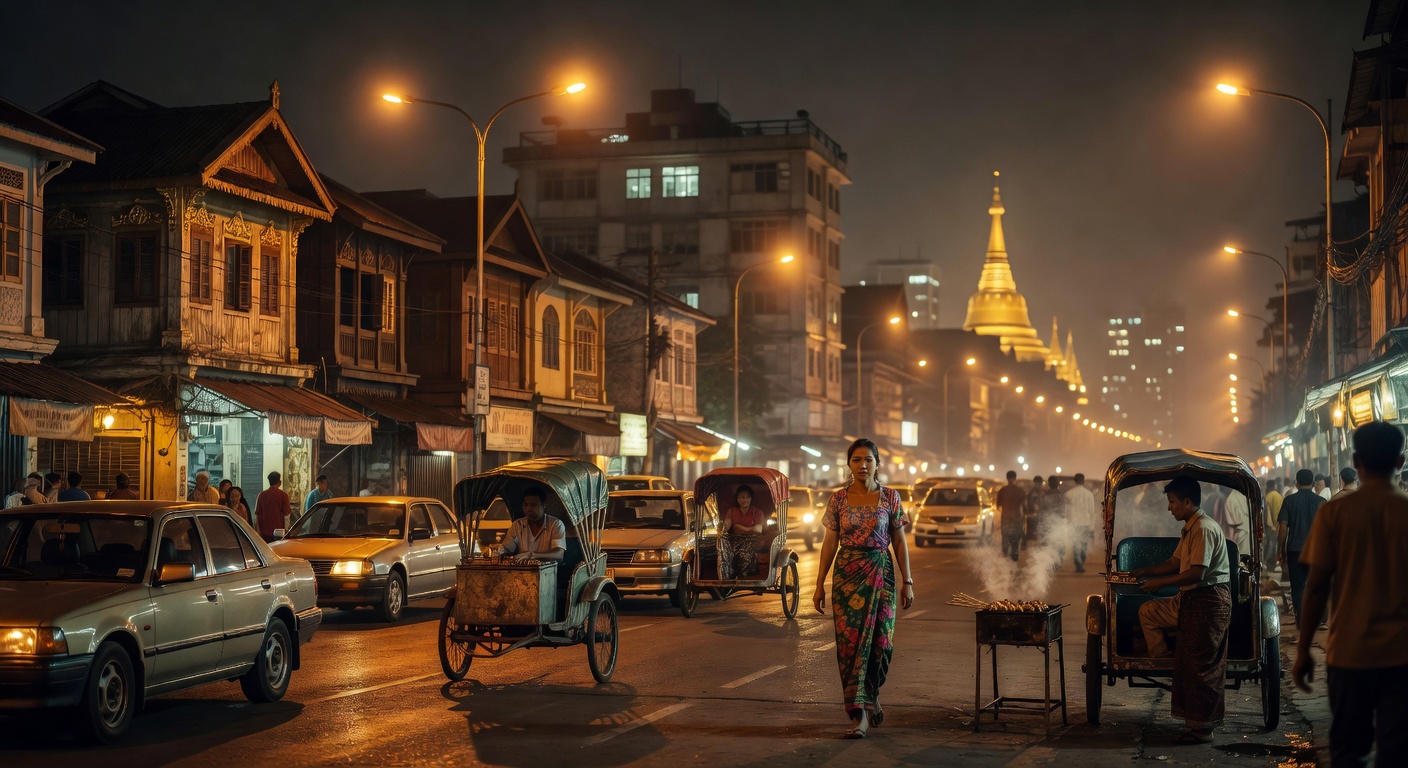
Country Guide
Myanmar
Illegal, conflict-torn and with no safe scene — the law and the real danger, stated plainly.
At a glance: Myanmar
- Legal model
- Illegal
- Currency
- Myanmar Kyat (MMK)
- Language
- Burmese
Common questions about myanmar
What people are actually searching for.
Is paying for sex legal in Myanmar?
No. Prostitution is a criminal offense under the Suppression of Prostitution Act of 1949, which remains in force and criminalizes soliciting, procuring, living off the earnings of prostitution, and keeping or managing a brothel. Those selling sex are frequently the ones arrested and detained, while clients and third parties are also exposed to prosecution. There is no legal, licensed, or regulated framework for sex work anywhere in the country, and enforcement under the current military administration is arbitrary.
What is the age of consent in Myanmar?
The age of consent is 16, with a narrow exception permitting sex within marriage from age 15. Any sexual contact with someone below these thresholds is a serious crime regardless of payment. Myanmar is also a documented origin country for the trafficking and sexual exploitation of minors, so the risk of unknowingly encountering an underage or coerced person is real and severe.
How dangerous is travel in Myanmar right now?
Since the military coup of February 2021, Myanmar has been under junta rule amid open civil conflict, and most Western governments — including the UK, US, Australia and Canada — advise against all travel to the country or to large parts of it. Fighting between the military and resistance and ethnic armed organizations affects Sagaing, Chin, Kayah, Kayin, Rakhine, northern Shan and other regions, with airstrikes, shelling, landmines and unexploded ordnance. Martial law, curfews, communications blackouts and roadblocks are common, and the security situation can change within hours.
Can you rely on calling the police for help in Myanmar?
The police emergency number is 199, but response is unreliable and effectively absent in conflict zones and after curfew. Encounters with police, soldiers and militia at checkpoints frequently involve demands for money, arbitrary questioning, phone searches and, in the worst cases, detention without clear charge or consular notification. Bribery is commonplace but unpredictable — paying may resolve a situation or may escalate it, with no way to know in advance.
What scams should travelers watch out for in Myanmar?
The most consequential risk is trafficking into cyber-fraud compounds along the eastern and northern borders, where people lured by fake job offers, or sometimes online romance or sexual bait, are held and forced to run investment and romance fraud; any offer involving crossing into a border enclave should be treated as a potential kidnapping. Within ordinary nightlife in the main cities, familiar hazards include inflated 'lady drink' and hostess bills, padded tabs, staged overcharging and pickpocketing. Extortion by people claiming to be police or officials is a particular risk, since anyone engaged in an illegal transaction has no way to dispute a charge or seek redress.
What health risks should travelers consider in Myanmar?
Myanmar's health system has been severely degraded since the coup, with many public hospitals disrupted, medical staff displaced, and shortages of medicines and safe blood; quality private care exists only in the largest cities, and serious illness or injury typically requires medical evacuation to Bangkok. The country carries one of the region's more significant HIV burdens, concentrated among key populations including sex workers and people who inject drugs, and reliable testing, treatment and PrEP are not dependably accessible. Malaria, dengue and waterborne disease are additional routine concerns, and comprehensive travel and evacuation insurance is essential.
Legal Model
Illegal (1949 Suppression of Prostitution Act)
Risk Level
High
Currency
Myanmar Kyat (MMK)
Language
Burmese
Emergency
199 (police)
Age of Consent
16
Overview
Myanmar is not a functioning adult-travel destination, and the honest answer is that there is no safe, organised scene to navigate here. Since the military coup of February 2021 the country has been under junta rule amid open civil conflict, and most Western governments — including the UK, US, Australia and Canada — advise against all travel to Myanmar or to large parts of it. The rule of law has collapsed across wide areas, consular assistance is severely limited, and the personal risks to any traveller far outweigh anything the pre-2021 tourist economy once offered.
Paid sex is illegal in Myanmar, and it always has been. Layer that ordinary criminality on top of martial law, arbitrary detention, active fighting, landmines and an economy in freefall, and the picture is unambiguous: this is a place to understand the danger, not to seek it out. This page exists to state the law plainly, describe the real hazards, and give honest, harm-reduction guidance for anyone who nonetheless finds themselves in the country — not to advertise a market that cannot be entered safely.
Legal Status
Prostitution is a criminal offence under the Suppression of Prostitution Act of 1949, which remains in force. The Act criminalises soliciting, procuring, living off the earnings of prostitution, and keeping or managing a brothel; those selling sex are frequently the ones arrested and detained, while clients and third parties are also exposed to prosecution. Additional Penal Code provisions on public decency and immorality are applied flexibly, and under the current administration charges can be laid arbitrarily and without meaningful due process.
The age of consent is 16, with a narrow exception permitting sex within marriage from 15. Any sexual contact with a person below these thresholds is a serious crime regardless of payment, and Myanmar is a documented origin country for the trafficking and sexual exploitation of minors — meaning the risk of unknowingly encountering an underage or coerced person is real and severe. Foreign nationals should also assume that visa conditions, registration requirements and immigration status give the authorities additional, easily invoked grounds for detention. There is no legal, licensed or regulated framework for sex work of any kind — no registration, no health certification, no sanctioned venues — so every transaction, everywhere in the country, sits wholly outside the law and outside any protection you might expect elsewhere in the region.
Practical Safety
The dominant safety threat in Myanmar is not the sex trade — it is armed conflict and the collapse of civil order. Fighting between the military and a range of resistance and ethnic armed organisations affects Sagaing, Chin, Kayah, Kayin, Rakhine, northern Shan and other regions, with airstrikes, shelling, landmines and unexploded ordnance. Martial law, curfews, communications blackouts and roadblocks are common, and the security situation can change within hours. Several foreign governments describe the risk as extreme and state that they cannot provide consular support across much of the country.
For any traveller the implications are stark: avoid conflict-affected regions entirely, never travel overland to remote border areas, and treat every checkpoint as a point of vulnerability to detention or extortion. Pursuing paid sex compounds these dangers by putting you in unregulated, unaccountable settings where you have no legal protection, no reliable way to summon help, and no consular safety net. If you feel unsafe, the correct move is to leave the situation and the country, not to negotiate within it.
Health Considerations
Myanmar's health system has been severely degraded since the coup, with many public hospitals disrupted, medical staff displaced, and shortages of medicines and safe blood. Quality private care exists only in the largest cities and is limited; serious illness or injury typically requires medical evacuation to Bangkok, and comprehensive travel and evacuation insurance is essential — though note that many policies exclude countries under an 'advise against all travel' warning.
Myanmar carries one of the region's more significant HIV burdens, concentrated among key populations including sex workers and people who inject drugs, and rates of other sexually transmitted infections are meaningful. Reliable testing, treatment and pre-exposure prophylaxis (PrEP) are not dependably accessible, and condom supply cannot be assumed. Anyone who is sexually active should carry their own condoms, understand that no partner's health status can be verified, and recognise that post-exposure prophylaxis and emergency care may be hours away or unavailable. Malaria, dengue and waterborne disease are additional routine concerns.
Common Scams
The most consequential scam connected to Myanmar is not a bar bill — it is human trafficking into cyber-fraud compounds, and it inverts the usual traveller assumptions. Along the eastern and northern borders, criminal networks run walled compounds where people lured by fake job offers, and sometimes by online romance or sexual bait, are held and forced to run investment and romance fraud. Foreigners have been trafficked into these operations; the 'opportunity' that draws people in is itself the trap. Treat any offer that involves crossing into a border enclave — for work, for a woman, for a casino, for anything — as a potential kidnapping.
Within the ordinary nightlife of the main cities the familiar hazards still apply: inflated 'lady drink' and hostess bills, padded tabs, staged overcharging and pickpocketing. In the current environment, extortion by people claiming to be police or officials is a particular risk, because a foreigner engaged in an illegal transaction is an easy target who cannot go to the authorities for redress. Because you are transacting illegally, you also have no way to dispute a charge, recover stolen property or report an assault without incriminating yourself, which is exactly why opportunistic operators target foreign clients. The safest defence against all of these is not to enter the transaction in the first place.
Police & Enforcement Reality
Law enforcement in Myanmar operates under a military administration, and the ordinary protections a traveller might expect do not reliably exist. The police emergency number is 199, but response is unreliable and effectively absent in conflict zones and after curfew. Encounters with police, soldiers and militia at checkpoints frequently involve demands for money, arbitrary questioning, phone searches and, in the worst cases, detention without clear charge or consular notification.
For a foreigner, being caught in an illegal sexual transaction means facing that apparatus with no leverage and no recourse. Bribery is commonplace but unpredictable — paying may resolve a situation or may escalate it, and there is no way to know in advance. Assume that any arrest can be prolonged, that access to a lawyer or to your embassy may be slow or denied, and that the immigration and reputational consequences can follow you long afterward. The honest calculus is that enforcement is both arbitrary and unaccountable, which makes any deliberate lawbreaking recklessly dangerous.
Cities & Where the Scene Is
This section deliberately does not map a scene, because doing so would be both dishonest and unsafe. Yangon, formerly Rangoon, remains the largest city and commercial centre, with the main international airport and what nightlife survives — hotel bars, karaoke and KTV lounges and restaurants concentrated in the downtown and inner townships. Mandalay, the second city, has a comparable but smaller footprint. Naypyidaw, the purpose-built administrative capital, is a spread-out government city with little public social life. In all of them, curfews and a subdued, wary post-coup atmosphere have hollowed out much of what existed before.
What organised paid sex exists is informal, illegal and typically routed through KTV and karaoke venues, massage parlours and personal contacts rather than any open red-light district — and engaging with it carries every legal and safety risk described on this page. Far more dangerous are the border towns: Myawaddy, adjacent to the notorious KK Park and Shwe Kokko compounds; Muse on the Chinese border; and autonomous enclaves such as Mong La and Wa State, which run casinos, unregulated vice economies and the trafficking operations described above. These are not tourist destinations; they are among the most dangerous places in Southeast Asia, and travellers should not go to them.
Local Trafficking Indicators
Myanmar is one of Asia's most serious human-trafficking contexts — a source, transit and destination country — and the coup and conflict have intensified it by displacing millions and destroying livelihoods. Women and girls are trafficked internally and to neighbouring countries for forced marriage and forced sex work, while the border compounds hold trafficked people of many nationalities in conditions of forced labour and sexual exploitation. The US State Department has consistently placed Myanmar at the lowest tier of its Trafficking in Persons rankings.
Indicators that a person may be coerced rather than acting freely include an inability to move, speak or hold their own documents; the presence of a controlling third party who negotiates and takes payment; signs of confinement, debt bondage, fear or physical harm; scripted or monitored communication; and youth or uncertainty about age. In an environment where trafficking is this pervasive, a client cannot reliably distinguish a coerced person from a consenting one — which is one more reason the honest guidance is non-participation. Paying for sex with a trafficked or underage person is a grave crime, and the surrounding circumstances here make that outcome disturbingly likely. If you encounter someone you believe is being trafficked and can do so safely, note what you can and report it to a credible anti-trafficking organisation or your own government rather than to local authorities.
Getting Around
Movement inside Myanmar is constrained by conflict, checkpoints and curfews, and large parts of the country are effectively off-limits. Yangon International Airport is the principal gateway, with a reduced schedule of international flights; domestic aviation still connects the main cities but is subject to disruption. Overland travel is where the greatest danger lies: roads pass through contested territory, buses and cars are stopped at military and militia checkpoints, and some regions are closed to foreigners outright or require permits. Overland border crossings — particularly into the eastern enclaves — should be avoided entirely.
Within cities, licensed taxis and ride-hailing apps (where they still operate) are the sensible way to move; use hotel-arranged transport at night, keep to well-known central areas, and respect curfew hours strictly, because being out during a curfew invites detention. Do not accept offers to be driven to a 'party', a casino or a woman in an outlying district or border town — that is precisely the pattern by which people are robbed, extorted or trafficked.
Money & Practicalities
Myanmar is a cash economy under sanctions, and ordinary international banking largely does not work here. The currency is the Myanmar Kyat (MMK). Foreign cards are widely unusable, ATMs are unreliable, and international sanctions on junta-linked banks complicate transfers; most visitors bring clean, new US-dollar banknotes in cash and exchange them locally. Be aware of a significant gap between official and market exchange rates and of frequent currency volatility. Carry cash discreetly and in a mix of denominations.
Because you cannot rely on cards or reliable connectivity, plan for cash across the whole trip, keep emergency funds separate, and hold a buffer for the possibility of needing to leave quickly, including a paid onward flight. Keep your passport, visa and any permits on you, along with photographs of them stored separately. A local SIM gives some connectivity, but assume communications can be cut, and never store anything on your phone — contacts, photos, messages — that would expose you or others during a checkpoint search.
Resources
In an emergency the police number is 199, ambulance 192 and fire 191, but treat all of them as unreliable outside the main cities and during curfews or unrest. Your most important resource is your own government: register with your embassy's traveller service before and during any visit, keep its emergency contact details to hand, and follow its travel advisories, which currently urge against travel to Myanmar or much of it. Comprehensive insurance with medical evacuation to Thailand is close to essential, since serious care often means leaving the country.
For anyone who encounters trafficking or exploitation, report to a recognised international anti-trafficking body or your own government rather than to local authorities, given the enforcement realities described above. For sexual-health needs, international-standard clinics exist only in the largest cities and cannot be assumed to stock PrEP or PEP; carry your own protection and any regular medication. The single most protective decision remains the simplest one — do not pursue an illegal transaction in a country where you have no legal protection, no reliable help, and every incentive working against you.