Regional Guide
Taiwan
A progressive democracy with a surprisingly ambiguous stance on sex work. Individual selling was decriminalized in 2011, but buying remains technically illegal under a Nordic-adjacent model that is rarely enforced. The result is a discreet, LINE-driven industry with strong Japanese cultural influence and a pragmatic don't-ask-don't-tell culture.
At a glance: Taiwan
- Legal model
- Legal & Regulated
- FCDO advisory
- Normal
- HIV prevalence
- 0.1% adult
- PrEP access
- Free
- Currency
- New Taiwan Dollar (TWD)
- Language
- Mandarin, Taiwanese; some English
- Population
- 23.6M
- Capital
- Taipei
- Last verified
ART: 88% · WHO 2024
Government travel advisories
Pre-travel medical — vaccines & medicines(8 · CDC)
- COVID-19Recommended
All eligible travelers should be up to date with their COVID-19 vaccines. Please see Your COVID-19 Vaccination for more information.
- Hepatitis ARecommended
Recommended for unvaccinated travelers one year old or older going to Taiwan. Infants 6 to 11 months old should also be vaccinated against Hepatitis A.
- Hepatitis BRecommended
Recommended for unvaccinated travelers of all ages traveling to Taiwan.
- MeaslesRecommended
Cases of measles are on the rise worldwide. Travelers are at risk of measles if they have not been fully vaccinated at least two weeks prior to departure, or have not had measles in the past, and trav…
- RabiesConsider
Dogs infected with rabies are not commonly found in Taiwan. Rabies is present in some terrestrial wildlife species.
- Routine vaccinesRoutine
Make sure you are up-to-date on all routine vaccines before every trip.
- Japanese EncephalitisNot recommended
Recommended for travelers who Are moving to an area with Japanese encephalitis to live Spend long periods of time, such as a month or more, in areas with Japanese encephalitis Frequently travel to are…
- Yellow FeverNot recommended
CDC recommendations: Vaccine is not recommended. Country entry requirements: Vaccine is not required. Updated April 23, 2025
General guidance from the CDC Travelers' Health page (2026-07-23) — not medical advice. See a travel clinic 4–6 weeks before departure. Malaria and some vaccines depend on your specific itinerary.
Common questions about Taiwan
What people are actually searching for.
Are happy endings legal in Taiwan?
Under Taiwan's Social Order Maintenance Act, paid sexual services (including massage-parlour "happy endings") are permitted only inside government-designated zones. In practice, no local government has established such a zone, so every commercial sexual transaction on the island is technically illegal. Enforcement, however, is uneven and generally lenient: police focus on trafficking, underage workers and street solicitation rather than discreet parlour extras. Foreigners are rarely targeted by vice sweeps, and prosecutions typically fall on the seller rather than the buyer. The nominal minimum age for any sex worker is 18. Because the activity sits in a tolerated grey zone, prices, quality and legal exposure vary widely between establishments in Taipei, Taichung and Kaohsiung, and no venue can advertise such services openly.
What is the legal sex age in Taiwan?
Taiwan sets two separate age thresholds that travellers should not confuse. The general age of consent for non-commercial sexual activity is 16, one of the lower thresholds in East Asia, though additional Child and Youth protections apply to anyone under 18. For commercial sex, the minimum age is strictly 18 — anyone paying for, arranging or providing sexual services with a person younger than that faces serious criminal penalties under child-protection statutes, regardless of the "designated zone" framework of the Social Order Maintenance Act. Because commercial sex is only lawful inside designated zones (none of which currently operate), the 18-year floor is enforced aggressively even when other aspects of adult entertainment are tolerated. Foreign visitors are held to the same standard as Taiwanese nationals.
Is Taiwan good for single men?
For a solo male traveller, Taiwan rates as a low-risk, high-comfort destination rather than a dedicated nightlife hub. Government advisories reflect this: the UK FCDO issues only a general warning, while Canada and Australia both recommend normal precautions. Personal safety, transport and healthcare are excellent, English is workable in Taipei, and foreigners are rarely targeted by vice enforcement. The adult scene is subdued compared with Bangkok or Manila — sex work is technically illegal outside non-existent designated zones — but Taipei's Linsen North Road hosts Japanese-style KTV and hostess clubs, Kaohsiung has nightlife around Liuhe Night Market, and Taichung's central district is lively. Typical commercial rates run TWD 4,000–10,000 (USD 120–300). Earthquake preparedness and building-evacuation awareness are worthwhile additions to any solo itinerary.
What are the top 3 countries for sex tourism?
This guide does not rank sex-tourism destinations, and the Taiwan country brief does not supply comparative data that would let us name a global top three. What can be said factually about Taiwan itself is that it is not one of Asia's headline sex-tourism markets: commercial sex is permitted only inside designated zones under the Social Order Maintenance Act, no such zones currently operate, and the scene is small, discreet and priced at TWD 4,000–10,000 (USD 120–300) per encounter. Visitors comparing Taiwan with neighbouring destinations should consult each country's own legal model, minimum-age rules and government travel advisory before travelling. For Taiwan specifically, the UK FCDO issues a general warning while Canada and Australia advise normal precautions, and foreigners are rarely targeted by vice enforcement.
What is not allowed in Taiwan?
In the adult-travel context, the clearest prohibition in Taiwan is commercial sex outside a government-designated zone. The Social Order Maintenance Act permits paid sexual services only inside such zones, but because no local authority has actually established one, every commercial transaction on the island is technically unlawful — even though enforcement is lenient and foreigners are rarely targeted. Any sexual activity, paid or unpaid, with a person under the relevant age threshold is strictly forbidden: the general age of consent is 16, and the minimum age for any commercial sex worker is 18, enforced aggressively. Street solicitation, trafficking and organised procurement attract the harshest penalties. Travellers should also respect Taiwan's earthquake-preparedness rules, learning building-evacuation procedures on arrival, and dial 110 for police or 119 for medical emergencies.
In what country is prostitution fully legal?
The Taiwan country brief does not list jurisdictions where prostitution is fully legalised, so we will not speculate. What it does document is Taiwan's own hybrid model: under the Social Order Maintenance Act, sex work is permitted only inside "designated zones" that local governments may establish. In practice no such zone currently operates anywhere in Taiwan, which means all commercial sex on the island is technically illegal but widely tolerated, with enforcement focused on trafficking, underage workers and street solicitation rather than adult clients. The minimum age for any sex worker is 18. Foreign visitors are rarely targeted by vice operations, and the UK FCDO issues only a general warning while Canada and Australia advise normal precautions. Anyone comparing regimes should check each destination's statutes independently.
Does Taipei have a red light district?
Taipei does not have an officially designated red-light district. Under the Social Order Maintenance Act, commercial sex is only lawful inside "designated zones," and the Taipei city government has never established one, so the capital has no legally sanctioned prostitution quarter. What exists instead is a concentration of adult nightlife along Linsen North Road, historically shaped by Japanese business travel and dominated by KTV rooms and hostess clubs rather than street-based sex work. Independent providers operate online across the city. Because the entire sector sits in a tolerated grey zone, venues do not advertise sexual services openly, foreigners are rarely targeted by enforcement, and typical rates for adult companionship run TWD 4,000–10,000 (USD 120–300). Emergency contacts in Taipei are 110 for police and 119 for medical.
How much is it for the Red Light District?
Because Taiwan has no operational designated zone and Taipei has no official red-light district, there is no single "admission" or standard rate. Pricing instead reflects the tolerated grey-zone venues clustered on Linsen North Road in Taipei, the Liuhe Night Market area of Kaohsiung, and Taichung's central nightlife district, plus independent providers who market themselves online. Typical rates for adult companionship in Taiwan run TWD 4,000–10,000, roughly USD 120–300, with hostess-style KTV rooms usually charging additional fees for drinks, room hire and sit-in time on top of any personal arrangement. Because commercial sex is technically illegal outside non-existent designated zones under the Social Order Maintenance Act, no venue publishes menus for sexual services, and quoted figures should be treated as indicative rather than fixed.
Legal Model
Gray Area
Risk Level
Medium
Currency
New Taiwan Dollar (TWD / NT$)
Language
Mandarin Chinese
Tipping
Not customary
Emergency
110 (Police) / 119 (Fire & Medical)
Legal Framework
Taiwan's legal approach to sex work is a study in contradictions. Prior to 2011, sex work was legal and regulated through a licensing system. The Social Order Maintenance Act was then amended following a Constitutional Court ruling that found penalizing only sellers (but not buyers) to be unconstitutional. Rather than legalizing the trade fully, the government adopted a quasi-Nordic model: individual selling was decriminalized, but buying sexual services remains technically illegal, carrying fines of NT$30,000 (approximately $900).
The law also contains a provision allowing local governments to designate "special zones" where the sex trade can operate legally. However, no city or county government has ever established such a zone — doing so would be political suicide in Taiwan's conservative local politics. This creates a legal limbo: the framework for legalization exists on paper but has never been implemented.
In practice, enforcement against buyers is virtually nonexistent. Police occasionally raid massage parlors and other venues, but these crackdowns target operators and traffickers rather than clients. The average foreigner engaging with a willing adult provider faces minimal legal risk, though the theoretical possibility of prosecution exists.
Key legal points:
- Selling sex individually is decriminalized — providers face no penalty for solo work.
- Buying is technically illegal — fines up to NT$30,000, but enforcement is rare against clients.
- Operating a brothel or pimping is illegal — organizing or profiting from others' sex work carries serious penalties.
- Trafficking is severely punished — Taiwan has strong anti-trafficking laws with sentences up to 7 years.
- Age of consent is 16 — commercial sex with anyone under 18 is a serious crime regardless of consent.
- No designated special zones exist — despite the legal provision, no local government has created one.
How It Works
Taiwan's sex industry operates on a model of studied discretion. The government, police, and society generally prefer not to see what they know exists. This creates an environment where services are widely available but never openly advertised. Understanding the unwritten rules is essential.
The LINE messaging app is the cornerstone of Taiwan's adult industry. LINE is to Taiwan what WhatsApp is to Europe or KakaoTalk to Korea — it is the universal communication tool, and the sex industry runs on it. Providers maintain LINE accounts, share IDs through word-of-mouth or discreet online forums, and conduct all negotiations through the app. Without LINE, your options are severely limited.
Taiwan's industry carries a strong Japanese cultural influence, a legacy of the colonial period (1895–1945) and ongoing cultural ties. This manifests in venue aesthetics, service styles, and the hostess entertainment model. Many venues are modeled directly on Japanese counterparts, and some providers speak basic Japanese alongside Mandarin.
Payment is overwhelmingly cash-based in New Taiwan Dollars. Some higher-end independents may accept bank transfers, but cash remains king for privacy and practicality. ATMs are ubiquitous across Taiwan, and international cards work reliably at most bank ATMs and convenience store machines.
Venue Types
Massage Parlors
The most common and accessible entry point for foreigners. Taiwan has a massive massage industry, and a subset of establishments offer sexual services. The spectrum ranges from legitimate therapeutic massage to full-service venues. Semi-legal parlors typically operate with a "base massage" price and negotiate extras directly with the masseuse. Look for establishments with curtained private rooms, late operating hours, and certain visual cues like pink lighting. Many are clustered around train stations and commercial districts.
Tea Houses (茶室)
A distinctly Taiwanese institution with historical roots. Traditional tea houses were social venues where men would drink tea, socialize, and meet women. The model has declined significantly but still exists in some areas, particularly in southern Taiwan. Modern tea houses that offer adult services tend to be discreet, member-oriented establishments. They are almost entirely Chinese-language only and difficult for foreigners to access without a local introduction.
KTV / Karaoke Bars
Private karaoke rooms (KTV) are a massive industry in Taiwan. Most are purely entertainment venues, but some operate a hostess model where female companions are provided for the room, pouring drinks, singing along, and socializing. Higher-end hostess KTVs may facilitate further arrangements, but this is not guaranteed and requires negotiation. The hostess KTV model is expensive, as clients pay for room time, food, drinks, and hostess fees.
Independent Escorts
The growing segment of Taiwan's industry, driven by LINE and online platforms. Independent providers advertise through forums, social media, and word-of-mouth LINE ID sharing. This channel offers the widest variety in terms of pricing and service but requires Mandarin communication skills or excellent translation app usage. Verification is limited — photos may not match reality.
Halfway Houses (半套店)
A uniquely Taiwanese venue type offering hand services (manual stimulation) only. These "half-service shops" are widely available, operate semi-openly, and represent the lowest-risk, lowest-cost option. They are essentially hand-job parlors with a thin veneer of massage legitimacy. While limited in scope, they are the most accessible and least legally problematic venue type.
Pricing Guide
| Venue / Service | Price (TWD) | Price (USD) | Notes |
|---|---|---|---|
| Massage Parlor (base + extras) | NT$2,000 – NT$4,000 | $60 – $120 | Base massage ~NT$800; extras negotiated with masseuse |
| Halfway House (hand service) | NT$800 – NT$1,500 | $24 – $45 | Manual services only; widely available |
| Independent Escort (mid-range) | NT$3,000 – NT$8,000 | $90 – $240 | Arranged via LINE; 1–2 hour sessions typical |
| Hostess KTV (per session) | NT$5,000 – NT$15,000 | $150 – $450 | Room + drinks + hostess fees; sex not included |
| High-End Escort / Model | NT$8,000 – NT$20,000+ | $240 – $600+ | Premium providers; overnight rates higher |
| Tea House | NT$3,000 – NT$6,000 | $90 – $180 | Declining availability; local introduction often needed |
Last verified: March 2026. Prices vary by city; Taipei is typically 20–30% more expensive than southern cities.
Key Cities
Taipei
The capital and largest market by far. Wanhua district (around Longshan Temple) is historically Taiwan's oldest red-light area, and while overt street activity has declined, massage parlors and discreet venues remain concentrated here. Linsen North Road is known for Japanese-influenced hostess bars and clubs, a legacy of decades of Japanese business travel. The area caters to both Japanese visitors and locals seeking that style of entertainment. Beyond these traditional areas, Taipei's industry has largely moved online, with LINE-based independents operating across the city. The Zhongshan and Songshan districts also have notable concentrations of massage parlors.
Kaohsiung
Taiwan's second-largest city and major southern port. Kaohsiung has a grittier, more working-class character than Taipei, and its adult industry reflects this — prices are lower and the atmosphere is less polished. The port area has historically attracted associated industries. The Yancheng and Qianjin districts have concentrations of massage parlors and older-style venues. Kaohsiung is less foreigner-oriented than Taipei, so Mandarin skills become more important here.
Taichung
Central Taiwan's largest city has a growing entertainment scene. The Yizhong Street night market area and surrounding commercial districts host massage parlors and KTV venues. Taichung has a younger demographic due to its universities, and this is reflected in some segments of the industry. The city is developing rapidly and its adult entertainment landscape is evolving alongside it.
Tainan
Taiwan's oldest city and former capital retains some traditional venue types, including tea houses, that have faded elsewhere. Tainan is more conservative than Taipei but has an established if discreet adult industry. Prices are the lowest of the major cities. The downtown and train station areas have the highest concentration of venues. English proficiency is lower here than in Taipei.
Finding Providers
LINE is your primary tool. Without a LINE account, you are cut off from the majority of Taiwan's adult industry. Set up LINE before arrival and familiarize yourself with its features. Methods for finding providers include:
- Online forums — Chinese-language forums discuss providers, share LINE IDs, and post reviews. Google Translate can help navigate these, though nuance is lost. Some international forums have Taiwan sections with English-language reports.
- Massage parlors — Walk-in exploration of massage establishments in known areas. Look for late hours, curtained rooms, and specific visual cues. Be polite and indirect when inquiring about services.
- Word of mouth — If you have local contacts or meet other foreigners familiar with the scene, personal recommendations are the most reliable channel.
- Hotel staff — In some business hotels and love hotels, staff may be able to point you toward services, though this is far from universal and should be approached with tact.
LINE App Essential
Install LINE and create an account before arriving in Taiwan. It is the primary communication tool for the entire country, not just the adult industry. Learn to use LINE's built-in translation feature for Mandarin conversations. Many providers will not respond to other messaging platforms.
Cultural Etiquette
- Indirectness is key — Taiwanese culture values subtlety. Blunt requests or crude language will shut doors. Approach negotiations with politeness and circumspection.
- Respect is reciprocal — Taiwan is one of Asia's most progressive societies on gender issues. Providers expect to be treated with basic human respect. Rudeness, aggression, or condescension will not be tolerated.
- Japanese influence — Many venues follow Japanese service conventions: meticulous attention to atmosphere, ritualized interactions, and emphasis on the experience beyond just the physical. Understanding and appreciating this elevates the encounter.
- Hygiene is paramount — Taiwanese people are fastidious about cleanliness. Shower before encounters (many venues provide showers), maintain good grooming, and be freshly dressed.
- No photography — Never photograph or record providers or venue interiors. This is a universal rule that carries both legal and social consequences.
- Remove shoes — In many private settings, shoe removal is expected. Follow the lead of the environment.
- Drinking culture is moderate — Unlike Korea or Japan, Taiwan does not have an aggressive drinking culture. In KTV settings drinks are expected but heavy intoxication is viewed negatively.
Safety
Scam Awareness
The most common scam targeting foreigners involves bait-and-switch with LINE-arranged meetups: photos do not match reality, or a provider agrees to meet and then a different person appears. Always verify before committing to payment. Another common pattern is massage parlors quoting one price for the base massage and then pressuring for escalating add-on fees. Clarify total costs before services begin.
- Taiwan is very safe overall — Violent crime against foreigners is extremely rare. Petty theft exists but at lower rates than most Asian destinations. The primary risks in the adult industry are financial (scams) rather than physical.
- Police raids are infrequent but happen — Usually targeting operators rather than clients. If caught up in one, cooperate fully, identify yourself as a tourist, and contact your country's representative office (Taiwan's unique diplomatic status means formal embassies are rare).
- Drug laws are strict — Taiwan classifies marijuana as a Category 2 narcotic. Possession can result in up to 3 years imprisonment. Harder drugs carry penalties up to life imprisonment or death. Do not assume Taiwan's progressive social attitudes extend to drug tolerance.
- Health precautions — Taiwan has excellent healthcare accessible to foreigners. Condoms are widely available at convenience stores (7-Eleven, FamilyMart are everywhere). HIV testing is available at hospitals and public health centers.
- Natural disasters — Taiwan experiences earthquakes and typhoons. Familiarize yourself with emergency procedures and keep your phone charged for alerts.
- Carry ID — Always have your passport or a copy on you. Random ID checks are not common but do occur, especially in entertainment districts.
Health & Safety Tip
Taiwan's National Health Insurance does not cover tourists, but medical costs are still very reasonable by Western standards. A doctor visit typically costs NT$500–1,000 ($15–$30). Emergency rooms are efficient and many doctors in Taipei speak English. Pharmacies (look for the green cross) stock basic medications without prescription.
Useful Phrases
| English | Mandarin | Pinyin |
|---|---|---|
| Hello | 你好 | nǐ hǎo |
| Thank you | 谢谢 | xièxie |
| How much? | 多少钱? | duōshao qián? |
| Too expensive | 太贵了 | tài guì le |
| Yes / No | 是 / 不是 | shì / bú shì |
| I don't understand | 我听不懂 | wǒ tīng bù dǒng |
| I don't speak Chinese | 我不会说中文 | wǒ bú huì shuō zhōngwén |
| Where is the bathroom? | 洗手间在哪里? | xǐshǒujiān zài nǎlǐ? |
| Cash only | 只收现金 | zhǐ shōu xiànjīn |
| You are very beautiful | 你很漂亮 | nǐ hěn piàoliang |
| Please help me | 请帮帮我 | qǐng bāngbang wǒ |
| Please call a taxi | 请帮我叫计程车 | qǐng bāng wǒ jiào jìchéngchē |
| Do you have LINE? | 你有LINE吗? | nǐ yǒu LINE ma? |
Travel Logistics
Taiwan is one of Asia's easiest and safest destinations for independent travelers, with excellent infrastructure, friendly locals, and a high degree of English signage in major cities.
- Getting there — Taiwan Taoyuan International Airport (TPE) handles most international flights. Taipei Songshan Airport (TSA) serves some regional routes including flights from Tokyo Haneda and Shanghai. The Taoyuan Airport MRT connects TPE to Taipei Main Station in about 35 minutes.
- Internal transport — Taipei's MRT metro system is clean, safe, efficient, and has English signage. The Taiwan High-Speed Rail (THSR) connects Taipei to Kaohsiung in under 2 hours. Local trains, buses, and the ubiquitous EasyCard (rechargeable transit card usable on most public transport, taxis, and convenience stores) make getting around simple.
- Accommodation — Hotels range from budget (NT$1,000–2,000/night) to luxury. Love hotels exist but are less prevalent than in Japan or Korea. Airbnb is widely available. Most hotels do not restrict guest visitors, but some budget establishments may.
- Communication — Prepaid SIM cards are available at the airport from Chunghwa Telecom, Taiwan Mobile, and FarEasTone. Data plans are cheap and coverage is excellent island-wide. Free Wi-Fi (iTaiwan network) is available in many public spaces. Install LINE before arrival.
- Cash and cards — Credit cards are accepted at hotels, restaurants, and major retailers. Cash is needed for night markets, small shops, and the adult industry. ATMs are everywhere — 7-Eleven and FamilyMart machines accept international cards. Taiwan has over 13,000 convenience stores in a country of 24 million people.
- Visa — Most Western passport holders receive visa-free entry for 90 days. Check current requirements as policies can change.
- Best timing — Entertainment venues are busiest Friday and Saturday nights. Avoid typhoon season (July–September) if possible. Major holidays like Chinese New Year see many venues close for a week or more.
- Food and nightlife — Taiwan's night market culture runs late (many until midnight or later), and entertainment districts are lively well past midnight on weekends. The food is exceptional and extremely affordable.
Deep Dive: Taipei's Linsen North Road
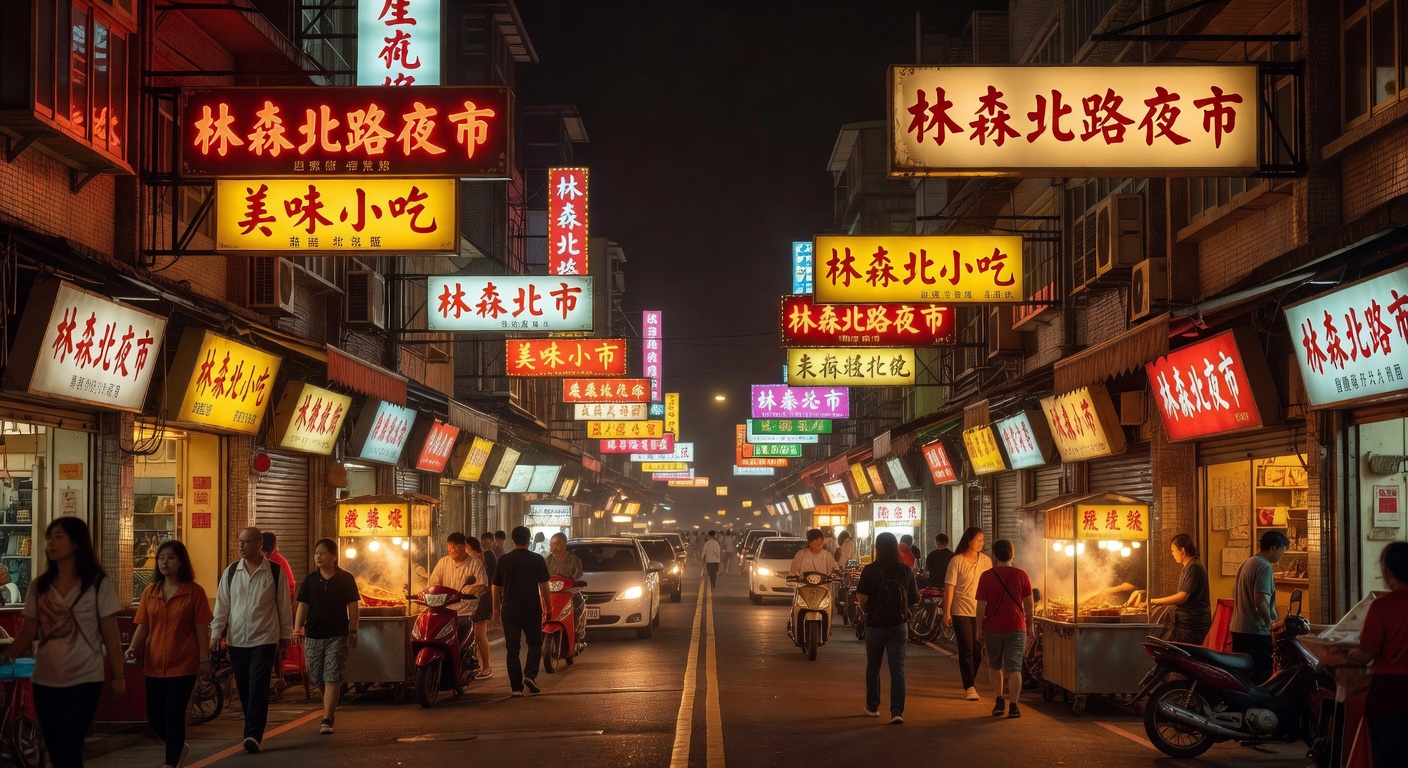
Linsen North Road (林森北路) is Taipei's most famous entertainment street and the beating heart of the city's Japanese-influenced hostess bar culture. Running north from Nanjing East Road through the Zhongshan district, Linsen North Road and its surrounding alleys pack dozens of hostess bars, KTVs, and "barber shops" into a compact entertainment zone.
The Japanese Connection
Linsen North Road's character is inseparable from its Japanese business ties. For decades, Japanese businessmen on expense-account trips to Taipei made this strip their nightlife headquarters. The result: many venues operate on Japanese models, with Japanese signage, Japanese-speaking hostesses, and pricing structures modeled on Tokyo's Ginza clubs. This Japanese influence has waned somewhat as Taiwan's economy has developed its own identity, but it remains the defining characteristic of the Linsen North Road scene.
"Barber Shops" (理髮店)
The "barber shop" (理髮店, lǐfà diàn) is one of Taiwan's most distinctive and misunderstood venue types. These establishments display spinning barber poles and signage advertising haircuts, but they have never been about grooming. Inside, you find dimly lit rooms, reclining chairs or beds, and women who offer services ranging from massage and hand jobs to full service. The barber shop is a holdover from an earlier era of Taiwanese sex work — an agreed-upon fiction that everyone understands.
Barber shops on and around Linsen North Road typically charge NT$1,000-2,000 ($30-60) for the base "service" (usually a massage with manual finish) and NT$2,000-4,000 ($60-120) for more comprehensive services. The quality varies enormously — some are clean, well-maintained establishments with attractive, friendly providers; others are dingy and perfunctory. These venues are almost exclusively Chinese-language — expect minimal English. A translation app or basic Mandarin is essential.
How to identify an operating barber shop: look for the spinning barber pole, curtained or frosted windows, and illuminated signage after dark. Most operate from late morning through late evening (10 AM-10 PM). Entering is straightforward — walk in, a mama-san or manager greets you, you choose from available providers (sometimes from a lineup, sometimes from photos on a wall), agree on the service level and duration, pay upfront, and proceed to a private room.
Hostess KTV on Linsen North Road
The hostess KTV (karaoke television) bars on Linsen North Road represent the highest-spending tier of Taipei's nightlife. These venues offer private rooms with hostesses who sing, pour drinks, flirt, and create a party atmosphere. The pricing model is structured around time and consumption:
- Room charge: NT$2,000-5,000 per hour, depending on room size and venue tier
- Hostess fee: NT$1,000-3,000 per woman per hour (the "sit fee" or 坐檯費)
- Food and drinks: NT$500-2,000+ per person (inflated prices are standard)
- Take-out (帶出, dài chū): If available, the bar fine to take a hostess out ranges from NT$5,000-10,000, with her personal fee on top (NT$5,000-15,000 depending on the establishment and the woman)
A typical evening at a hostess KTV on Linsen North Road easily runs NT$10,000-30,000 ($300-900) per person before any take-out arrangements. This is not a budget option — it is entertainment spending comparable to bottle service at a premium nightclub. The experience, however, is unique: the combination of karaoke, attentive female companionship, flowing drinks, and the ritualized social dynamics of the hostess bar format creates something you cannot replicate elsewhere.
Important caveat: not all hostess KTVs on Linsen North Road facilitate take-outs. Some are purely entertainment venues where the hostesses' role ends when you leave the room. Others operate a more flexible model. The distinction is not always clear upfront — ask discreetly through the mama-san or manager if this is important to your plans.
Wanhua District: Taipei's Historic Red Light Area
Wanhua (萬華), centered around Longshan Temple and the surrounding old streets, is Taipei's oldest district and its historic red-light area. While the overt sex trade has diminished significantly from its heyday (the famous "Snake Alley" sex shows are long gone), Wanhua retains a concentration of older-style venues — tea houses, massage parlors, and barber shops — that operate with the quiet tolerance of the local community.
The area around Huaxi Street Night Market (formerly Snake Alley) and the alleys branching off from Guangzhou Street still host a handful of establishments. These tend to be older, more basic operations catering to a local clientele rather than tourists. Pricing in Wanhua is at the lower end of the Taipei range: massage parlors with extras NT$1,500-3,000, barber shops NT$1,000-2,500. The providers tend to be older than those on Linsen North Road, and the atmosphere is less polished. Wanhua is for visitors who appreciate the historical context and do not mind a grittier, more authentic experience.
Getting to Wanhua: take the MRT Blue Line to Longshan Temple station (exit 1 or 3). The area is walkable from the station. Wanhua is also interesting from a cultural perspective — Longshan Temple itself is one of Taipei's most beautiful and historically significant temples, and the surrounding night market offers excellent street food.
Betel Nut Beauties (檳榔西施)
Betel nut beauties (檳榔西施, bīnláng xīshī) are a uniquely Taiwanese cultural phenomenon that deserves explanation even though they are not strictly part of the sex industry. Along highways and in suburban areas across Taiwan, small glass-walled kiosks sell betel nut (a mild stimulant chewed by truck drivers and laborers). The innovation: staffing these kiosks with young, often provocatively dressed women to attract customers.
At their peak in the 1990s and 2000s, betel nut beauty kiosks were everywhere, and some operated as informal meeting points where transactions beyond betel nut sales could be arranged. The phenomenon has diminished significantly due to government crackdowns on skimpy dress codes and changing social attitudes. Today, most surviving betel nut kiosks are more conservatively operated, and the overtly sexualized version is largely a relic — though you will still spot illuminated kiosks with attractive women along highways, particularly in southern Taiwan.
For visitors, betel nut beauties are a cultural curiosity rather than a practical avenue. They represent Taiwan's fascinating ability to create indigenous entertainment formats that blend commerce, sex appeal, and local culture in ways that exist nowhere else.
Tea Houses (茶室 / 酒茶館): The Traditional System
The traditional tea house (茶室, cháshì, or the more colloquial 酒茶館, jiǔchá guǎn) system is Taiwan's oldest institutional format for commercial sex, with roots stretching back through the Japanese colonial period. While significantly diminished, tea houses have not disappeared entirely and offer a window into a distinctly Taiwanese tradition.
How Tea Houses Work
The traditional tea house operates as follows: you enter a small, often nondescript establishment (typically in older neighborhoods). A mama-san manages the venue and maintains a roster of women — some present on-site, others on-call. You sit, are served tea (hence the name), and the mama-san presents available women for your selection. You choose, agree on terms through the mama-san, pay the house fee, and retire to a private room on the premises or at a connected short-time hotel.
Tea house pricing: the house fee is typically NT$1,500-3,000, which covers the room and the mama-san's commission. The provider's fee is NT$2,000-4,000 for a session (usually 30-60 minutes). Total: NT$3,500-7,000 ($105-210). Tea houses do not accept walk-ins from strangers easily — most require an introduction from a known client or at minimum a phone call to the mama-san before visiting. This exclusivity has kept them under the radar but also limits accessibility for foreign visitors.
Tea houses are concentrated in southern Taiwan — particularly Tainan and Kaohsiung — where traditional culture is more preserved. In Taipei, they exist but are harder to find and access. The clientele is predominantly local Taiwanese men, many of them regulars who have relationships with specific mama-sans spanning years or decades. For foreign visitors without local connections, tea houses are difficult to access but represent a genuinely unique cultural experience if you can gain entry through a local introduction.
LINE App: The Essential Tool
The importance of LINE to Taiwan's sex industry cannot be overstated. If you do not have LINE installed and active before arriving in Taiwan, you are cutting yourself off from the majority of available providers. Here is the detailed playbook:
- Setup: Download LINE (free) and create an account before your trip. You will need a phone number for verification. Use your regular phone number — the account is permanent and works worldwide.
- Finding LINE IDs: Providers share their LINE IDs on Chinese-language forums, social media profiles, and through word-of-mouth. Some advertisements in classified sections of Taiwanese websites include LINE IDs. The format is typically a mix of letters and numbers (e.g., "beauty_taipei_2025").
- First contact: Add the provider's LINE ID. Send a brief, polite message introducing yourself — your age, nationality, when you will be visiting, and what you are looking for (in general terms). Many providers will ask you to send a photo of yourself or verify your identity before responding.
- Negotiation: All terms — services, duration, price, location — are discussed via LINE. Use LINE's built-in translation feature for Mandarin conversations if your Chinese is limited. Be clear and direct but not crude. Agree on everything before meeting.
- Verification: Ask for a verification photo (a current photo holding a specific object or making a specific gesture) to confirm the person matches their advertised photos. Providers who refuse verification may be using fake photos.
- Payment and meeting: The provider gives you an address (usually their apartment) and a meeting time. Arrive on time. Payment is in cash, upfront.
Massage Parlors: Taipei Area-by-Area
Taipei's massage parlor scene with extras is concentrated in several specific areas. Knowing which neighborhoods to target saves time and increases your chances of finding what you are looking for:
- Zhongshan district (中山): The area around Linsen North Road and the surrounding blocks has the highest concentration of massage parlors offering extras. Many operate on upper floors of commercial buildings, marked by small signs in the stairwell or elevator. Pricing: base massage NT$800-1,200, extras NT$1,000-3,000 on top.
- Songshan district (松山): Near Taipei Arena and the surrounding commercial area, several massage establishments offer services ranging from legitimate therapy to full extras. Less tourist-oriented than Zhongshan, which can mean less foreigner-friendly but also less inflated pricing.
- Wanhua district (萬華): As discussed above, the Longshan Temple area has traditional-style massage parlors. These tend toward the budget end (total NT$1,500-3,000) with older providers and more basic facilities.
- Datong district (大同): Between Taipei Main Station and Minquan West Road, scattered parlors operate in older buildings. Similar character to Wanhua — local-oriented, budget pricing, limited English.
- Ximending (西門町): Taipei's youth shopping district has a few massage venues in the commercial buildings, though the area is more known for conventional nightlife (clubs, bars) than sex industry venues.
Taichung Scene
Taichung (台中), Taiwan's third-largest city, has a growing entertainment scene that offers an alternative to Taipei at lower prices and with a more relaxed pace. The key areas:
- Yizhong Street (一中街): The night market and commercial area near Chung Hsing University attracts a young crowd. KTV venues and some massage parlors are concentrated in the surrounding blocks. The university presence creates a younger provider demographic in some online channels.
- Taichung Park area: The older commercial district around Taichung Park and the historic train station has traditional-style venues — barber shops, tea houses, and massage parlors. Pricing is 20-30% below Taipei.
- Feng Jia Night Market area: Taiwan's largest night market draws enormous crowds nightly. The surrounding area has some entertainment venues, though the night market itself is a food and shopping destination.
- LINE-based independents: Taichung has a growing pool of independent providers advertising on forums and reachable via LINE. Expect 15-30 active profiles at any given time — fewer than Taipei but enough to provide genuine choice. Pricing: NT$2,000-5,000 ($60-150) per session.
Taichung is connected to Taipei by High-Speed Rail (THSR) in about 50 minutes, making day trips feasible. The city is worth an overnight stay for its excellent food scene (some argue Taichung has better street food than Taipei), the National Taichung Theater, and the relaxed atmosphere.
Kaohsiung Harbor Area
Kaohsiung (高雄), Taiwan's second-largest city and major southern port, has the grittiest and most working-class sex industry of Taiwan's major cities. The harbor area — particularly the Yancheng (鹽埕) and Qianjin (前金) districts — retains the character of a port town that has served sailors and travelers for generations.
- Yancheng district: The area around Dayi Street (大義街) and the old commercial port has massage parlors and traditional establishments. This is old Kaohsiung — narrow streets, aging buildings, and venues that have operated for decades. Pricing is the lowest of Taiwan's major cities: massage with extras NT$1,200-2,500, barber shops NT$1,000-2,000.
- Liuhe Night Market area: The blocks surrounding Kaohsiung's famous night market have a few massage parlors and KTV venues. More tourist-accessible than Yancheng.
- Zuoying/HSR station area: The newer, more modern part of Kaohsiung (near the high-speed rail station and Lotus Pond) has limited adult entertainment — the scene remains concentrated in the older central and port districts.
- Online/LINE: Kaohsiung has an active LINE-based independent scene. Expect pricing 30-40% below Taipei: NT$2,000-4,000 ($60-120) per session. The provider pool is predominantly local Taiwanese rather than the international mix found in Taipei.
Kaohsiung is accessible from Taipei via THSR (1 hour 35 minutes) and has its own international airport (KHH) with regional flights. The city has invested heavily in urban renewal — the Love River waterfront, Pier-2 Art Center, and the MRT system make it increasingly attractive as a destination in its own right.
Pricing Ranges Across Taiwan — Quick Reference
- Taipei massage parlor (full extras): NT$2,000-4,000 ($60-120)
- Taipei barber shop (full service): NT$2,000-4,000 ($60-120)
- Taipei LINE independent (mid-range): NT$3,000-6,000 ($90-180)
- Taipei hostess KTV (take-out total): NT$15,000-30,000+ ($450-900+)
- Taichung massage/barber shop: NT$1,500-3,000 ($45-90)
- Taichung LINE independent: NT$2,000-5,000 ($60-150)
- Kaohsiung massage/barber shop: NT$1,200-2,500 ($36-75)
- Kaohsiung LINE independent: NT$2,000-4,000 ($60-120)
- Tainan tea house (total): NT$3,500-7,000 ($105-210)
- Halfway house (hand service only, any city): NT$800-1,500 ($24-45)
The pattern is clear: prices decrease as you move south from Taipei, and online/LINE independents offer the best value relative to quality across all cities. Hostess KTV is the luxury option that primarily serves the business entertainment market.
Taiwan's Unique Position
Taiwan occupies a unique niche in Asian sex tourism: safer and more orderly than the Philippines or Thailand, cheaper and more accessible than Japan or Korea, with a cultural openness and genuine warmth that makes encounters feel personal rather than purely transactional. The LINE-driven independent market offers excellent value — use the budget calculator to compare city tiers and plan trip costs. Review the scam guide and health precautions before travel.