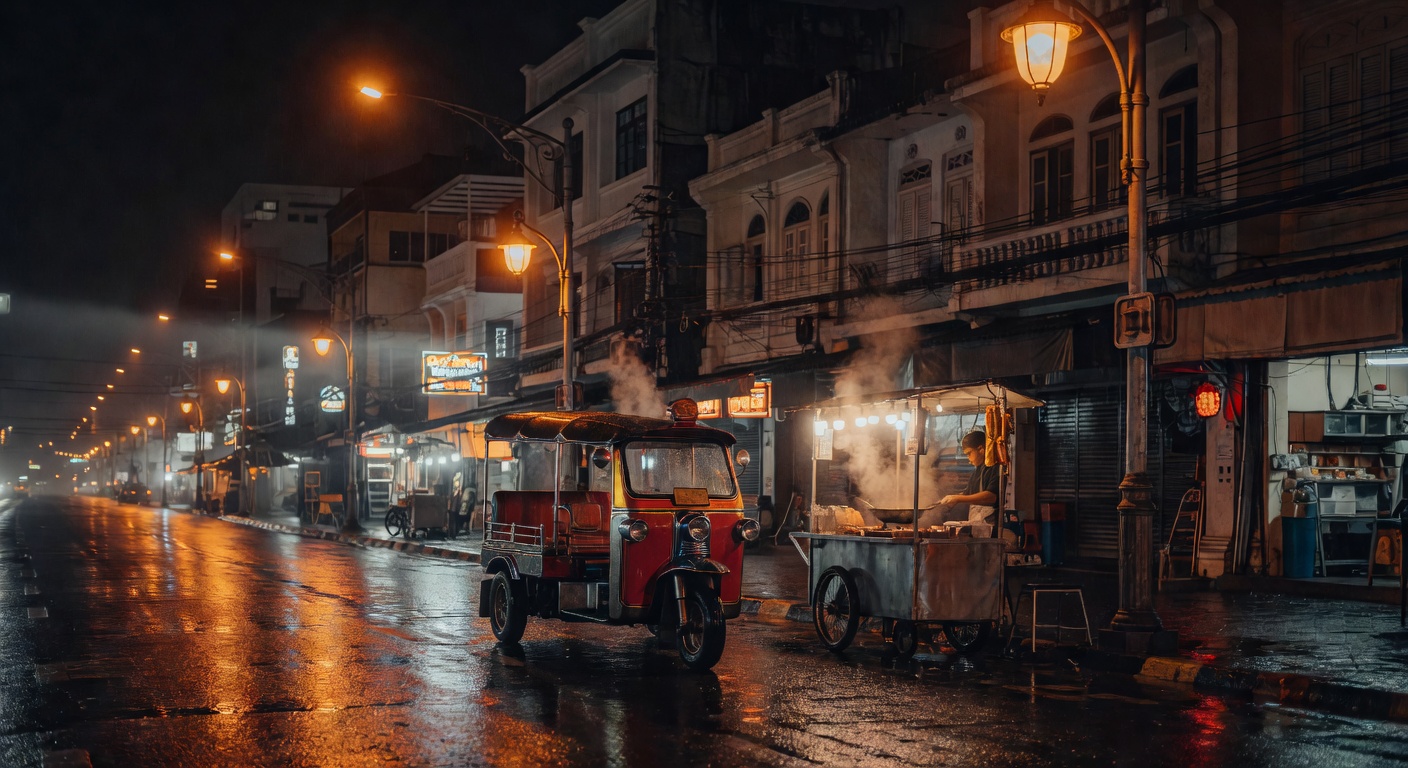
Thailand · City Guide
Bangkok
What an adult visitor to Bangkok needs to know about the law, the health picture, the scams, and where enforcement actually lands.
City facts
- Population
- 5.7M
- Region
- Thailand
- Area
- 2K km²
- Timezone
- UTC+07:00
Overview
Bangkok is one of the most heavily marketed adult-nightlife destinations in Asia, and that reputation is built on a legal fiction: commercial sex is technically illegal in Thailand, yet it operates openly through a licensed nightlife industry that the state taxes, tolerates, and periodically raids. For a visitor, this gap between the law on paper and the reality on the street is the single most important thing to understand. Nothing you see in the go-go bars of Nana or Soi Cowboy is formally legal, but very little of it is prosecuted, and the people most exposed to legal risk are the workers, the venue operators, and anyone who crosses one of the genuinely hard lines the state does enforce.
The adult scene is geographically concentrated and easy to identify. Three long-established zones dominate the tourist-facing trade, all in central Bangkok and all within a short ride of the elevated BTS Skytrain: the Sukhumvit corridor (home to Nana Plaza and Soi Cowboy), and Patpong in the Silom district. Alongside these are venues aimed at domestic and regional customers rather than Western tourists, including the large massage-and-"soapland" complexes along Ratchadaphisek and the Japanese-oriented hostess bars of Thaniya. Each has a distinct clientele, price structure, and risk profile.
This guide takes a harm-reduction approach. It does not promote or discourage anything; it sets out what Thai law actually says, where the real dangers are (which are more often financial and health-related than violent), how the common scams work, and what genuinely triggers police action. The goal is an informed adult who can avoid the two outcomes that ruin trips: getting fleeced, and unknowingly crossing into conduct Thailand punishes severely.
Legal Status
The governing statute is the Prevention and Suppression of Prostitution Act B.E. 2539 (1996), which came into force in December 1996. It criminalises selling sex, soliciting "in an open and shameless manner" or in a way that causes public nuisance, procuring, and operating a "prostitution establishment." Penalties on the individual seller are small (a fine and, in principle, up to about a month's detention), while penalties on pimps, procurers, and premises operators are far heavier. Notably, buying sex from an adult is not itself an offence under the Act; the customer only commits a crime when the other person is under 18. The nightlife venues themselves are licensed separately under the older Entertainment Places Act B.E. 2509 (1966), which is how bars, go-go clubs, and massage parlours operate legally as "entertainment venues" while the sexual services negotiated inside them remain officially unlawful.
The hard lines are about age and coercion, and they are enforced. Thailand's general age of consent under the Criminal Code is 15, but for commercial sex the threshold is 18, and the penalties escalate sharply as age drops. Under the 1996 Act, sex with a commercial partner aged 15 to 18 carries a prison term measured in years, and sex with anyone under 15 is treated as a grave offence with heavier imprisonment and large fines. A foreigner cannot rely on being deceived about age; "she looked older" is not a defence that keeps people out of prison. Coercion, debt bondage, and movement of people into the trade fall under the separate Prevention and Suppression of Human Trafficking Act B.E. 2551 (2008), amended in 2015 and 2019, which carries severe sentences and is a priority for Thai authorities under international scrutiny.
Reform has been discussed for years, including proposals to decriminalise adult sex work and reforms to entertainment-venue licensing and alcohol hours, but as of 2026 the 1996 Act remains the operative law. Thailand did legalise same-sex marriage under the Marriage Equality Act that took effect in January 2025, and the city is broadly relaxed about LGBTQ visitors, but that social openness does not change the formal illegality of commercial sex. Treat the grey zone as exactly that: tolerated in practice, illegal on paper, and enforceable at the state's discretion.
Practical Safety
Violent crime against tourists in the nightlife districts is uncommon by international standards, and Bangkok is generally safe to walk at night in the central areas. The realistic dangers are financial disputes, over-intoxication, and theft rather than assault. The most common bad night involves a padded bill: a bar tab that balloons because of "lady drinks" bought for staff, unexplained service charges, or a bill for an upstairs "show" that was never disclosed. Keep a running mental tally, settle in cash where possible, and question a bill on the spot and calmly before it escalates. Disputes that end badly usually do so because a customer becomes aggressive or refuses to pay anything at all, at which point venue security gets involved.
Drink-spiking and drug-facilitated theft are the more serious risks. Incidents cluster around unlicensed after-hours venues, freelance encounters made through apps or on the street, and situations where a stranger accompanies a visitor back to their room. The classic pattern is a spiked drink followed by the victim waking with phone, cash, watch, and cards gone. Watch your drink, be wary of anyone unusually eager to leave with you quickly, and treat a partner you have known for twenty minutes as a stranger, because they are. Counterfeit and adulterated recreational drugs are a genuine hazard; despite cannabis being decriminalised in 2022, other substances remain illegal and unregulated, and drug charges in Thailand are handled harshly.
Standard precautions cut most of the remaining risk. Use the hotel safe, carry a photocopy of your passport rather than the original where practical, split your cash, and avoid unlicensed taxis touting outside venues late at night. If something goes wrong, the tourist-police hotline (see Resources) has English-speaking operators and is the right first call for anything short of a medical emergency.
Health Considerations
Thailand has a mature, well-resourced sexual-health system, and Bangkok in particular offers some of the best confidential testing and prevention services in Asia. HIV prevalence is concentrated in specific populations rather than the general public, but sexually transmitted infections including gonorrhoea, chlamydia, syphilis, and hepatitis circulate in the nightlife economy, so barrier protection and testing are the baseline. Condoms are sold everywhere, cheaply, in pharmacies and convenience stores. Do not rely on a partner or venue to supply them.
Pre-exposure prophylaxis (PrEP) and post-exposure prophylaxis (PEP) are both widely available in Bangkok. PEP must be started quickly after a potential exposure, ideally within hours and no later than 72 hours, so knowing where to go before you need it matters. The Thai Red Cross Anonymous Clinic, run by the Thai Red Cross AIDS Research Centre, is a long-established, genuinely anonymous facility offering HIV and STI testing, PrEP, and PEP, and it is used to serving foreigners. Bangkok also has excellent private hospitals with international patient services and full sexual-health capability, including Bumrungrad International Hospital, Bangkok Hospital, and Samitivej Hospital; these are more expensive than public clinics but fast, English-speaking, and discreet. Public-sector STI clinics attached to the city and the hospitals also provide low-cost testing.
Practical harm reduction: carry your own condoms, get a baseline test before travelling and a follow-up test on return, and if a condom fails or you have an unprotected higher-risk exposure, seek PEP immediately rather than waiting to see symptoms. Alcohol is the biggest single factor in unprotected encounters, so pace yourself. Travel insurance that covers Thailand is worth having; private care is good but not free.
Common Scams
Bangkok's tourist scams are well-documented and repetitive, which makes them easy to avoid once you know the scripts. The most expensive nightlife scam is the surprise bill, most notoriously associated with certain upstairs "ping-pong show" bars around Patpong. A tout offers a cheap or free show; once inside, drinks arrive unrequested and the final bill runs to thousands of baht, enforced by intimidating staff at the door. The defence is simple: do not follow touts to upstairs shows, and never enter a venue where you cannot see a price list. If you are trapped in a bill dispute, paying a contested amount and then reporting to the tourist police is usually safer than a physical confrontation, but the far better move is not going in.
The gem scam is a long-running Bangkok classic and unrelated to nightlife but frequently targets the same solo male tourists: a friendly local, sometimes posing as a teacher or official, steers you toward a "government-approved" jewellery shop with unbeatable tax-free prices; the gems are near-worthless and non-refundable. Treat any stranger who volunteers to be your guide, or who tells you a temple is "closed today" but knows somewhere else to go, as an opening move. Similarly, the tuk-tuk "10-baht tour" is a commission-driven loop through shops and tailors rather than a bargain ride.
Inside the adult economy, the recurring plays are the padded bar tab (inflated lady-drink counts and vague "service" line items), the freelance overnight theft (a partner who empties the room while you sleep or after a spiked drink), and rigged ATM or card scenarios where a card is skimmed or a machine "eats" it. Use ATMs attached to bank branches, keep cards in sight, and prefer cash for nightlife spending so a single tap cannot drain an account. Agreeing on all prices explicitly and in advance, and keeping the amount you carry limited, defuses most of these before they start.
Police & Enforcement Reality
Enforcement in Bangkok's adult districts is selective, periodic, and shaped more by politics and publicity than by consistent application of the 1996 Act. Ordinary transactions between adults are effectively ignored most of the time; the industry is visible, taxed through the licensed-venue system, and woven into the local economy. What actually triggers hard enforcement is a short list: anyone underage, evidence of trafficking or coercion, drugs, and periodic crackdowns on venues operating outside licence hours or after a high-profile incident that forces the authorities to act. When a raid happens, it tends to sweep a specific venue and its patrons, and being caught in the wrong place at the wrong time can mean detention and processing even if you personally did nothing beyond being present.
Bangkok has a dedicated Tourist Police service, reachable on a national hotline with English-speaking operators, and they are the appropriate contact for scams, disputes, theft, and harassment. They are generally more useful to a foreign visitor than a walk-in to a local district station. Be aware that low-level corruption exists; petty-offence stops, particularly around drugs or minor public-order matters, can turn into informal fines, and it is wise to stay calm, be polite, and ask to contact the tourist police or your embassy rather than resolving anything through a roadside cash payment you cannot verify.
The one area where there is zero discretion and zero tolerance is minors and trafficking. Thailand faces sustained international pressure on child protection and human trafficking, cooperates with foreign law enforcement, and prosecutes these cases aggressively; foreign nationals are convicted and imprisoned, and many home countries also prosecute their own citizens for child sexual offences committed abroad. There is no grey zone here, no negotiation, and no plausible-deniability defence. If a situation feels wrong on age or on freedom-to-leave, walk away immediately.
Neighborhood Overview
The tourist-facing adult nightlife concentrates in three zones, each with its own character. Nana Plaza, on Sukhumvit Soi 4 beside the Nana BTS station, is a multi-storey courtyard of go-go bars and beer bars and is the busiest, most tourist-dense of the go-go complexes. A few minutes east, Soi Cowboy, a short pedestrianised lane between Sukhumvit Soi 21 (Asok) and Soi 23, is a neon-lit strip of go-go bars that is more compact and, by reputation, slightly more relaxed than Nana. Both sit on the Sukhumvit line and are served by Asok BTS and the connecting Sukhumvit MRT station.
Across the city in the Silom district, Patpong (running between Silom Road and Surawong Road, near Sala Daeng BTS and Silom MRT) is the oldest of the tourist red-light areas and now blends go-go bars with a busy night market; it is also the epicentre of the upstairs-show bill scams described earlier, so it rewards caution. The parallel lane of Thaniya nearby is oriented toward Japanese customers, with hostess bars where language and etiquette expectations differ. Silom Soi 2 and Soi 4 are the heart of the city's gay nightlife.
Beyond the tourist strips are venues serving mainly Thai and regional clientele. The Ratchadaphisek road area (on the MRT Blue Line) is known for large massage-and-"soapland" complexes and Thai-style entertainment venues that Western tourists rarely enter and where prices and customs are set for locals. Scattered along Sukhumvit are quieter wine bars and hostess bars, notably around Soi 33. The clubbing district of RCA (Royal City Avenue) is mainstream nightlife rather than adult trade. As a rule of thumb, the further you move from the three tourist zones, the cheaper and more locally-priced things become, but also the less English is spoken and the more important it is to confirm every price up front.
Local Trafficking Indicators
Human trafficking is a real feature of parts of the regional sex economy, and Thailand is a source, transit, and destination country, with many workers coming from Myanmar, Laos, and Cambodia. As a visitor, you are not an investigator, but recognising red flags matters both ethically and legally, because engaging with a trafficked or coerced person, or with a minor, exposes you to the most serious offences in Thai law. The warning signs are consistent: a person who does not control their own passport or documents, who cannot freely leave the premises, who appears to be working off a "debt," who is closely watched or spoken for by a third party, who does not speak the language and seems disoriented about where they are, or who appears underage or is vague and evasive about age.
Coercion is not always visible on the surface, but freedom-to-leave and the presence of a controlling third party are the signals that most reliably distinguish an independent adult worker from a trafficked one. Debt bondage, in which someone is told they must work off recruitment or travel "debts," is the mechanism that underpins much of the coercion in the region and is specifically targeted by the 2008 anti-trafficking law.
If you encounter a situation that looks like trafficking or involves someone who may be underage, the correct response is to disengage immediately and, if you can do so safely, report it. Thailand operates anti-trafficking and child-protection hotlines, and the tourist police can take reports; internationally, child-exploitation tips can be routed through home-country agencies. Doing nothing when a minor is involved is not a neutral choice, and participating is a serious crime in both Thailand and, for most visitors, their own country.
Getting Around
Central Bangkok is well served by two clean, cheap, air-conditioned rail systems, and they are the fastest way to move between the nightlife districts while avoiding both traffic and taxi disputes. The elevated BTS Skytrain runs the Sukhumvit Line (with Nana and Asok stations for Nana Plaza and Soi Cowboy) and the Silom Line (with Sala Daeng for Patpong), interchanging at Siam. The underground MRT Blue Line connects at Sukhumvit station (beside Asok) and Silom station, and reaches the Ratchadaphisek area. Both run until roughly midnight, so plan a later exit accordingly.
After the trains stop, the ride-hailing app Grab is the most reliable and dispute-free option, because the fare is fixed and recorded in advance and you avoid the meter-refusal games that some street taxis play late at night. Metered public taxis are legitimate and inexpensive when the driver uses the meter; insist on "meter" before getting in, and simply decline any driver who quotes a flat fare near a nightlife zone. Motorbike taxis (identifiable by numbered vests) are quick for short hops and cheap, though riskier in traffic. Tuk-tuks are a tourist experience rather than efficient transport and are the vehicle most associated with commission-scam "tours," so agree the fare first and refuse any unrequested detour to a shop.
Where to Stay
Choice of base is mostly about which district you want to be near and how much late-night noise you can tolerate. The Sukhumvit corridor around Nana, Asok, and Phrom Phong is the most convenient single area for the go-go districts, sitting directly on the BTS and MRT and offering the full range from budget guesthouses to international five-star hotels; the trade-off is that the lower Sukhumvit sois are lively and loud at night. The Silom and Sala Daeng area is the counterpart near Patpong, close to the Silom Line, generally more business-oriented, and quieter a couple of streets back from the nightlife.
A practical detail specific to Bangkok is the hotel "guest policy." Many hotels are "guest-friendly" and permit an overnight visitor with no fuss, while others charge a "joiner fee" for a second guest or refuse outside visitors entirely, sometimes requiring the visitor's ID to be logged at reception. This is a normal and openly discussed part of the market; if it matters to you, confirm the specific property's policy directly before booking rather than assuming. For safety, prefer a hotel with a staffed 24-hour front desk and in-room safe, keep valuables secured, and be aware that logging a visitor's ID at reception is a legitimate security practice, not a scam. As always, this guide is descriptive and non-promotional: choose accommodation on location, safety, and reviews, and confirm policies with the property.
Resources
For emergencies, the general police number in Thailand is 191 and the medical emergency and ambulance number is 1669. The Tourist Police operate a nationwide hotline on 1155 with English-speaking operators, and this is the best first contact for scams, theft, disputes, harassment, or any non-medical trouble in the nightlife districts.
For sexual health, the Thai Red Cross Anonymous Clinic (run by the Thai Red Cross AIDS Research Centre) provides confidential, anonymous HIV and STI testing plus PrEP and PEP, and is experienced with foreign visitors. For fast private care with international patient services, Bumrungrad International Hospital, Bangkok Hospital, and Samitivej Hospital all offer full sexual-health services in English. Remember that PEP is time-critical after a possible exposure, so act within 72 hours and ideally within hours.
For issues around sex-worker rights, coercion, and trafficking, Thailand has established civil-society organisations, including the SWING (Service Workers in Group) Foundation, which provides health services and outreach to sex workers in Bangkok, and the Empower Foundation, which advocates for sex workers' rights and welfare. If you encounter suspected trafficking or anyone who may be underage, disengage and report it to the tourist police or the relevant anti-trafficking and child-protection hotline; for most visitors, child-exploitation offences committed in Thailand are also prosecutable in their home country. When in doubt about any legal, health, or safety question on the ground, contact your embassy or consulate, which can advise on local services and, if necessary, legal representation.