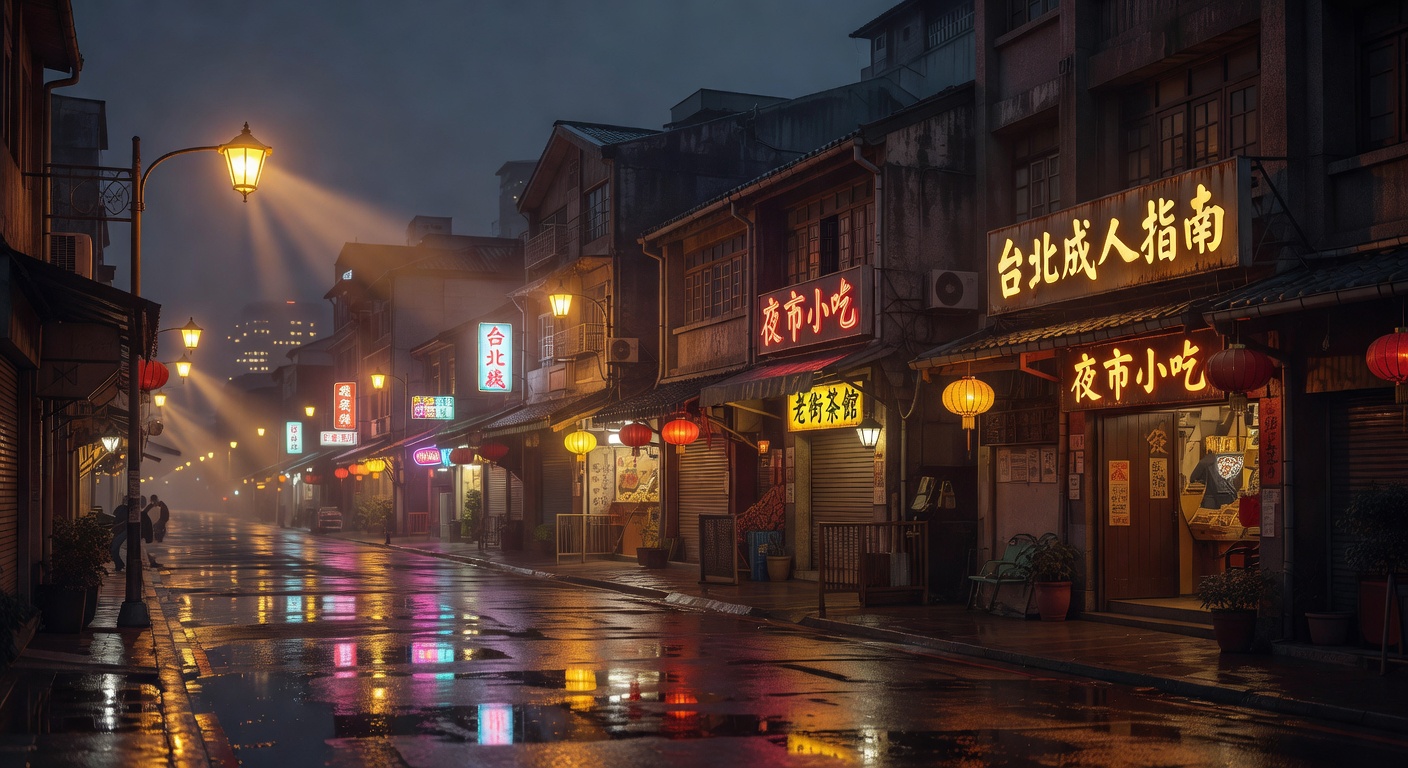
Taipei Adult Guide 2026: Linsen North Road, Ximending, Massage, KTV & Legal Reality
A detailed guide to Taipei's adult entertainment landscape — the historical significance of Linsen North Road, Ximending's contemporary nightlife, the massage parlor ecosystem, the unique barber shop euphemism, KTV hostess bar culture, Taiwan's complex legal situation since the 2011 abolition of licensed zones, pricing in TWD, the significant language barrier, safety considerations, and the cultural context that makes Taipei different from every other Asian destination.
Taipei's Adult Scene: Uniquely Taiwanese
Taipei defies easy categorization among Asian adult destinations. It is not Bangkok — there are no go-go bars, no beach-resort sex tourism infrastructure, and no tolerance zone with explicit commercial activity. It is not Tokyo — there is no organized "fuzoku" (adult services) industry with standardized categories and published menus. It is not Shanghai — the legal risk for foreign visitors, while real, is far lower than mainland China's draconian enforcement system.
What Taipei has is a scene that is deeply embedded in Taiwanese social culture, primarily serving the domestic market, almost entirely conducted in Mandarin Chinese (traditional character variant), and maintained through a network of establishments whose adult dimensions are understood by locals but completely invisible to most foreign visitors. The barber shop that is not quite a barber shop. The KTV that goes slightly further than singing. The massage parlor where the menu has an unwritten supplement. And beneath all of this, the legal framework that has been in flux since 2011 — illegal in theory, tolerated in practice to a degree, contested politically, and subject to periodic enforcement that affects the most visible operations while leaving the rest untouched.
Taipei also has a genuinely excellent conventional entertainment scene: world-class night markets, outstanding Taiwanese food, some of Asia's best independent music venues, a sophisticated bar scene, and a young urban population that is educated, internationally connected, and welcoming toward foreign visitors. The city does not need its adult scene to justify a visit — but for those who want to explore it, this guide provides the most complete English-language breakdown available.
Legal Framework: The 2011 Abolition and Its Consequences
Understanding Taipei's adult scene requires understanding what happened legally in 2011 and why its consequences continue to shape the market today.
Before 2011: The Licensed Zone System
Taiwan operated a licensed prostitution zone system for decades under Japanese colonial-era foundations and subsequent KMT-era regulation. Licensed "special zone" businesses operated semi-openly in designated areas, with workers registered, health-checked, and paying taxes. The system was imperfect and exploitative in various ways, but it created a regulated space that provided some legal clarity for workers and clients alike. Taipei's Wanhua district (particularly the Bopiliao and Huaxi Street area) and elements of the Linsen North Road corridor were associated with this tolerated zone system.
The 2011 Abolition
In 1998, the Taipei City Council voted to abolish the special zones, citing women's rights concerns and pressure from feminist advocacy groups. The transition was supposed to happen over several years and include alternative economic opportunities for workers. In practice, the abolition was implemented without adequate support for workers, and the Constitutional Court subsequently (in 2009) ruled that criminalization of sex workers while clients went free was discriminatory — creating a period of genuine legal uncertainty.
The Social Order Maintenance Act reforms, which took effect in 2011, were supposed to resolve this. The result was technically a criminalization of both buying and selling, but with a significant caveat: the law targeted establishments and public solicitation more than individual consensual transactions in private settings. Enforcement priorities shifted toward visible street solicitation and organized establishments rather than individual workers in apartments or hotels.
The Current Legal Reality (2026)
- Commercial sex in private: Technically illegal but rarely enforced against individual adult consensual transactions. Police enforcement focuses on organized operations, establishments with identifiable management, and visible street solicitation.
- Organized establishments (KTV, massage parlors offering adult services, barber shops): Illegal. Subject to periodic police operations. The risk of a raid is real but episodic — many establishments operate for years without enforcement, then face a sudden campaign.
- Street solicitation: Illegal and actively enforced. Wanhua's street scene (which was significant through the 2000s) was substantially reduced by consistent enforcement pressure and remains a minor fraction of what it was.
- Tolerance zones debate: There has been persistent political advocacy for creating tolerance zones where sex work could be permitted in designated areas with health and safety oversight. As of 2026, no such zones exist nationally, though the debate resurfaces regularly in the Legislative Yuan.
- Foreign nationals: Subject to the same criminal law as Taiwan nationals for buying sexual services. Enforcement against foreign visitors is not the police priority, but being caught in a raid on an establishment would result at minimum in detention, questioning, and potential deportation-level consequences including visa revocation and entry bans.
Linsen North Road (林森北路): Historical Center, Current Reality
Linsen North Road in the Zhongshan District is to Taipei what Rue Saint-Denis was to Paris or what the Reeperbahn is to Hamburg — a street whose adult associations are so deep in the city's cultural memory that the name itself carries meaning, even as the physical reality has changed dramatically.
The Historical Scene
Linsen North Road developed as an adult entertainment corridor primarily during the Japanese colonial period and expanded significantly during the Vietnam War era when American military personnel on R&R leave in Taipei created enormous demand. Bars, hostess establishments, and associated services concentrated along the road and its side streets through the 1970s, 1980s, and 1990s. The area became a significant concentration of Japanese-oriented entertainment businesses as Japanese businessmen became the dominant non-domestic client base from the 1980s onward. Japanese-style "snack bars" (スナック), karaoke lounges with hostesses, and massage establishments created a Japanese-facing entertainment economy within Taipei.
What Linsen North Road Looks Like in 2026
The change since even 2015 is substantial. Linsen North Road today is a mixed-use commercial and residential corridor. Some of the historic adult-oriented establishments remain, particularly in the side streets (the lanes and alleys off the main road, particularly around the Zhongshan MRT area). But significant portions of the strip have been replaced by: convenience stores, trendy cafes, co-working spaces, and the general apparatus of contemporary Taipei urban life.
The establishments that remain with adult orientations are concentrated in:
- The alley network between Linsen North Road and the parallel Zhongshan North Road, from approximately MRT Zhongshan station north to Xingtian Temple: This several-block area still has the highest density of "hostess bar" type establishments, clubs where women sit with clients and the evening involves companionship, songs, and drinks at premium prices with the possibility of private arrangements afterward.
- The side streets east of Linsen between Minsheng East Road and Nanjing East Road: Some of the more traditional establishments — Japanese-oriented snack bars, small clubs — survive here, though at reduced scale compared to the peak years.
Finding these establishments as a foreign visitor requires either specific advance knowledge or willingness to explore the alleys, look for the particular visual cues (soft lighting, women visible near the entrance, signs in Japanese in some cases), and navigate interactions that will entirely happen in Mandarin Chinese or Japanese.
Barber Shops: The Taiwanese Euphemism
The "barber shop" (理髮廳, lǐfàtīng, or 檳榔西施 in a different but related commercial tradition) is a uniquely Taiwanese adult cultural institution that anyone spending time in the country will encounter, even if they don't initially understand what they're looking at.
The Classic Barber Shop
A traditional Taiwanese barber shop offering adult services looks, from the outside, roughly like a conventional hair cutting shop — a glass-fronted storefront, barber chairs visible, simple signage. Inside, services nominally include haircuts and shaves. In practice, at many such establishments, the "service" extends to a massage portion of the session, and depending on the establishment and the specific worker, the session may extend further still.
This institution is so ingrained in Taiwanese adult culture that it has its own vocabulary. "Barber shop" or "lǐ fà diàn" understood in the right context means something specific that everyone above a certain age in Taiwan understands. The practice is concentrated in smaller cities and industrial suburbs more than in central Taipei — larger cities have more sophisticated indoor options — but barber shops with adult orientations exist throughout the Taipei metropolitan area, concentrated in areas like Wanhua, Zhonghe (New Taipei), and the outer Taipei industrial districts.
Betel Nut Beauties (檳榔西施)
A related and distinctly Taiwanese phenomenon: betel nut stands staffed by young women in revealing clothing ("betel nut beauties") are a visible feature of Taiwan's roads, particularly highways and in southern Taiwan. The stands sell betel nut (a mild stimulant chewed across much of Asia) with the appeal of the female servers as a marketing tool. At some stands, the service extends beyond betel nut. This is more of a regional Taiwan phenomenon than a central Taipei one — the highway-oriented betel nut beauty culture is less visible in the capital's urban core — but it's worth understanding as part of the broader Taiwanese adult cultural context.
KTV and Hostess Bars: The Dominant Domestic Model
As in Shanghai (though at lower prices and in a different cultural context), KTV venues and hostess bars are the primary commercial adult entertainment format for domestic Taiwanese male clients. The format — private karaoke rooms with female companions managing drinks and providing entertainment — is well-established and relatively accessible compared to the hidden barber shop culture.
Types of KTV in Taipei
Family/chain KTV (大型KTV): Venues like Holiday KTV, Cashbox (錢櫃), and Party World (好樂迪) are legitimate, mainstream entertainment venues used by couples, friends, and families. No adult services. These are the KTV venues tourists typically encounter if they search for "karaoke Taipei" online. Rooms rent for 300-800 TWD per person for 2-4 hours including a food/drink package.
Hostess KTV (小型KTV, 酒店): The domestic adult entertainment model. Private rooms with female companion service. The woman (小姐, xiǎojiě) sits with the client(s), pours drinks, sings, and provides company. Prices are structured: room fee plus companion fee per hour. Companion fees at mid-range establishments: 800-2,500 TWD per hour. Whether anything beyond companionship occurs depends on the establishment, the woman, and private negotiation.
酒家 (jiǔjiā) and 酒店 (jiǔdiàn): Traditional Taiwanese hospitality drinking establishments with female company. These predate the KTV format and still exist, particularly catering to older Taiwanese male clientele and business entertainment contexts. Service structure similar to hostess KTV but in a dining/drinking rather than karaoke format.
Accessing Hostess KTV as a Foreign Visitor
This is genuinely difficult without Chinese language ability or an introduction through a local contact. Hostess KTV establishments are:
- Operated entirely in Mandarin Chinese
- Often don't advertise in ways accessible to foreign visitors
- Concentrated in areas (the alleys off Linsen, the entertainment buildings of Dunhua South Road, the hospitality strip around Xinyi) that require knowing where to look
- Wary of foreign visitors because the legal risk perception is higher and communication difficulties create operational problems
The practical access pathway for foreign visitors is: hotel concierge at a business hotel who can make a referral, or local contact who is willing to accompany or introduce. Independent cold-walk access to mid-range or upper establishments is very difficult.
Massage Parlors
The massage sector is the most accessible part of Taipei's adult scene for foreign visitors, because the basic transaction can happen with limited Mandarin, some establishments in tourist areas have enough English to handle basic requests, and the format is internationally recognizable.
Legitimate Massage in Taipei
Taipei has an excellent legitimate massage culture rooted in traditional Chinese medicine (TCM), reflexology, and sports massage. Foot massage shops (腳底按摩) are ubiquitous — you'll find them in every night market and on every major commercial street. A 60-minute foot massage costs 350-600 TWD at legitimate shops. Full-body TCM massage at reputable chains (Dragon Palace, etc.) costs 500-900 TWD per hour.
This legitimate sector is the baseline from which adult-oriented establishments deviate. The visual and operational cues that distinguish a conventional massage shop from one with adult services are similar to those in Thailand or Taiwan's peer cities: curtained windows rather than transparent storefronts, emphasis on private rooms rather than open-plan layouts, female staff at the door, and a slightly different clientele profile (mostly male, mostly alone).
Areas with Adult-Oriented Massage Concentration
- Wanhua District (萬華區): Historically the most explicit part of Taipei's adult geography — the area around Huaxi Street (华西街, sometimes called "Snake Alley" due to its former snake meat restaurants, now largely a tourist market) was Taipei's most visible prostitution zone during the licensed period. The adult massage establishments that remain are on the streets around Guang Zhou Street and the Longshan Temple area, operating discreetly within the commercial fabric of a neighborhood that has always mixed the respectable and the seedy.
- Zhongshan District (alleys off Linsen): As noted above, some massage establishments in the alley network between Linsen and Zhongshan maintain adult dimensions. More discreet and oriented toward the same clientele as the hostess bars in the same area.
- Xinyi District (新北市 commercial area): Higher-end establishments in the commercial buildings near Taipei 101 and the Xinyi entertainment district cater to business travelers. Less visible on the street, operated through referral or specific knowledge.
- New Taipei peripheral areas (Zhonghe, Yonghe, Banqiao): Larger concentrations of budget-oriented massage establishments in the dense residential suburbs immediately adjacent to Taipei proper. These areas are effectively part of the Taipei metropolitan area but are served by different administrative jurisdictions (New Taipei City rather than Taipei City), which historically affected enforcement patterns.
Massage Pricing (2026)
- Foot massage (legitimate, 60 min): 350-600 TWD
- Full-body massage (legitimate): 500-900 TWD per hour
- Oil massage with happy ending: 1,200-2,500 TWD
- Full-service massage session: 2,000-4,500 TWD
Ximending: Youth Nightlife and the Adjacent Scene
Ximending (西門町) is Taipei's youth culture epicenter — the equivalent of Tokyo's Harajuku, centered on Zhonghua Road and the surrounding pedestrian streets near Ximen MRT station. It's characterised by pop idol stores, cosplay shops, bubble tea chains, tattoo parlors, indie clothing boutiques, and a thriving LGBTQ+ scene anchored by Red House (the historic octagonal building and surrounding bars).
What Ximending Is and Isn't
Ximending is not an adult entertainment zone in the commercial sex sense. The neighborhood is oriented toward youth culture, LGBTQ+ affirmation, and mainstream nightlife. What it has, at its margins and in the later night hours, is the same ambient freelancer and informal arrangement scene that exists anywhere in a major city with dense nightlife — young people in social environments, some of whom are open to arrangements.
The Red House LGBTQ+ bar area (the bars on the south side of the historic building) is Taipei's most open gay nightlife scene. This is genuinely welcoming to foreign visitors and has good English capability among the bar staff. Gay adult services in Taipei operate through apps (Grindr, Scruff, Jackd, and Taiwan-specific apps like Hornet) rather than through the commercial establishments that characterize the heterosexual market.
Taipei's LGBTQ+ Context
Taiwan legalized same-sex marriage in 2019 — the first country in Asia to do so. This reflects a genuinely open LGBTQ+ culture that makes Taipei among the most gay-friendly destinations in Asia. The annual Taipei Pride parade (October) is one of Asia's largest. The ambient social acceptance translates into a comfortable atmosphere for gay foreign visitors that is dramatically different from mainland China, Japan's more closeted culture, or Southeast Asian destinations. Gay adult services are easily accessible, app-mediated, and relatively risk-free from a legal and social enforcement perspective.
Online Platforms and Apps
The online market for adult services in Taipei has moved substantially to private messaging channels following platform shutdowns, though some directory sites persist.
- PTT (批踢踢): Taiwan's dominant bulletin board system — essentially a text-based Reddit that still commands enormous traffic in Taiwan. The adult-related boards (NightMarket, Sex, and various coded sub-communities) contain information about Taipei's commercial sex scene written in traditional Chinese. Requires registration and is entirely in Traditional Chinese — inaccessible without language ability but invaluable as a research tool for those who have it.
- Dcard: Taiwan's major social networking site for college students. Less explicit than PTT but the community knowledge is accessible. Again, Traditional Chinese only.
- LINE app: Taiwan's dominant messaging app (equivalent to WeChat for the Chinese mainland). Adult services are arranged through LINE in the same way WeChat is used in China — contact numbers circulated through networks, groups accessible through introduction. Essential to have the app installed.
- International platforms (EscortAdvisor, Skokka): Limited Taiwan coverage. The international escort directory market has not developed for Taiwan the way it has for European destinations. Some listings exist but coverage is thin compared to the actual scale of the market.
Language Barriers: The Biggest Practical Challenge
The language barrier in Taipei is more significant than in Bangkok (where many workers have basic English from the tourist economy) but less complete than in Shanghai (where English is rarer and the script is completely different for most Western visitors). Traditional Chinese (繁體中文) uses the traditional character system rather than simplified characters — there are differences from mainland Chinese text that matter if you try to use mainland-China-oriented learning resources.
Practical Language Strategies
- Google Translate camera: Works well with Traditional Chinese. Point your camera at signage, menus, or text to get real-time translation. Essential tool for navigating ambiguous venues.
- Basic Mandarin phrases: A small number of Mandarin phrases — 多少錢 (how much?), 一個小時 (one hour), 我不懂 (I don't understand) — can go a significant distance in a pinch. Taiwan's Mandarin has a different accent from mainland Chinese (softer, with different vocabulary in places) but is mutually intelligible.
- Japanese: An unexpected advantage. Given Linsen North Road's historical Japanese-client orientation and the general Japanese cultural influence in Taiwan (the colonial period left a durable imprint), Japanese is spoken by a meaningful proportion of older workers in the Linsen area. If you speak Japanese, you have a notable advantage in this specific zone.
- Google Translate voice: Speak English, hear Mandarin output. Clunky for real conversation but functional for basics. Most smartphones manage this well enough.
- Hotel concierge language assistance: At Taipei's major international business hotels (Grand Hyatt, Shangri-La, W Hotel), bilingual concierge staff can help navigate venues if you approach the request appropriately.
Safety in Taipei
Taipei is one of Asia's safest major cities. Violent crime rates are extremely low, tourists are treated well, and the police are professional if not entirely friendly toward the adult market. Specific safety considerations:
- Physical safety: Minimal risk across the city, including Wanhua (which has a tough reputation among locals but is safe by any international standard). Keep phone and wallet ordinarily secure but there's no need for the heightened vigilance required in, say, parts of Bangkok or Bucharest.
- Legal risk: Real but manageable. The most likely enforcement scenario is a raid on an established physical venue. Being present in a raided venue means detention, questioning (in Mandarin), and potential deportation proceedings. The risk is higher at walk-in establishments than through private online arrangements. The risk is highest during enforcement campaigns that occasionally precede major events.
- Scams: Less prevalent than in Southeast Asia. The most common issue is miscommunication about pricing due to language barriers rather than deliberate fraud. Confirm prices (using calculator app if necessary) before proceeding.
- Health: Taiwan has excellent healthcare infrastructure. National Taiwan University Hospital (NTUH) has English-capability staff. Comprehensive STI testing is available privately without stigma at major hospital outpatient departments.
Transport
Taipei has one of Asia's best metro systems (MRT). Single rides cost 20-65 TWD depending on distance. The iPass card (悠遊卡, 100 TWD initial charge, 100 TWD credit) works on MRT, buses, and YouBike (bike sharing) and should be your first purchase at the airport. Key stops:
- MRT Zhongshan (中山): For Linsen North Road and the surrounding nightlife/hostess bar area
- MRT Ximen (西門): For Ximending youth culture and LGBTQ+ scene
- MRT Longshan Temple (龍山寺): For Wanhua District
- MRT Taipei 101/World Trade Center: For Xinyi entertainment district
Uber and LINE Taxi are the best after-hours transit options. Traditional taxis are generally honest but communication with non-Mandarin speakers can be difficult — use the app-based options which allow address input without verbal communication.
Cultural Context: Why Taipei Is Different
Taipei's adult scene is embedded in specific Taiwanese cultural dynamics that distinguish it from any other city in Asia.
Taiwan's position between mainland Chinese cultural heritage, Japanese colonial influence, and its own democratic, progressive, post-martial-law identity creates an adult culture that is socially conservative in some dimensions (KMT-era social norms, traditional family structures, face culture) and openly progressive in others (same-sex marriage, robust civil society, women in senior public life at rates higher than mainland China or Japan). Commercial sex exists in this tension — tolerated in practice, politically contested, and not part of any Western-style "sex positivity" framework, but also not subject to the moralistic religious condemnation that shapes the debate in, say, the United States.
Taiwanese men of a certain age and economic position consider KTV and hostess bar entertainment a normal part of business and social life. This is not a marginal or countercultural behavior — it is a mainstream part of the Taiwanese entertainment economy that generates significant tax revenue and employment. The paradox of 2011 illegality alongside practical tolerance is a product of exactly this social reality: the behaviors are too widespread and economically embedded to suppress, but the legal framework that openly permitted them became politically untenable.
Pricing Summary (TWD)
- Foot massage (legitimate, 60 min): 350-600 TWD
- Full-body massage (legitimate): 500-900 TWD per hour
- Oil massage with happy ending: 1,200-2,500 TWD
- Full-service massage session: 2,000-4,500 TWD
- KTV companion (hostess, per hour): 800-2,500 TWD
- KTV room rental (private, 2 hours): 800-2,000 TWD
- Post-KTV private arrangement: 2,000-5,000 TWD
- Online-arranged private escort (1 hour): 2,500-6,000 TWD
- Overnight: 8,000-20,000 TWD
- Drink (Ximending bar): 120-250 TWD
- MRT single ride: 20-65 TWD
- Uber cross-city: 200-400 TWD
As of mid-2026, approximately 32-33 TWD to the USD, 35-36 TWD to the EUR. Taiwan is broadly comparable in cost to Japan or South Korea for visitor expenses — more expensive than Southeast Asia, cheaper than Western Europe.
Recommended Approach for Foreign Visitors
For foreign visitors to Taipei who want to explore the adult scene with minimal risk and maximum clarity:
- Install LINE before travel: Set up a LINE account with your home phone number. This is the primary communication channel for private arrangements.
- Focus on massage sector first: The foot massage and body massage sector is the most accessible without language skills. Legitimate venues are excellent on their own merits. Adult-oriented options exist and are findable with patience, particularly in Wanhua and the Linsen area side streets.
- Be a spectator at Linsen: Walk the alleys around Linsen North Road between Minquan East Road and Minsheng East Road on an evening. Observe the landscape. Venues where you want to inquire will have women near the entrance who manage initial contact. Without Mandarin, expect communication difficulties but not outright hostility.
- Approach KTV with local introduction: If you have access to a Taiwanese business contact, this is the pathway to the KTV experience. Without introduction, the mainstream family KTV chains (Cashbox, Party World) are excellent entertainment venues that happen to not include adult dimensions.
- Use international platforms for higher-tier arrangements: EscortAdvisor and similar have limited Taiwan coverage, but what listings exist tend to be genuine workers who have bothered to build an English-accessible presence specifically to serve the foreign visitor market.
For broader Taiwan coverage including non-Taipei cities, see our guides on Kaohsiung and Taichung. For the broader East Asian comparison, see our Shanghai and Tokyo guides.